Tour Villa de Leyva – A Colombian Time Capsule
Tour Highlights
- Explore one of Colombia's best-preserved colonial towns, declared a national monument
- See the Plaza Mayor, one of the largest colonial squares in the Americas
- Visit the Ecce Homo Monastery and its stunning Mudéjar cloisters
- Discover the Pozos Azules (Blue Pools) and dramatic desert landscape of the Boyacá region
- Optional: visit the fossil museum featuring a 120-million-year-old Kronosaurus
Tour code
COBOG-VDL01
Duration
Full day
Start
Hotel pickup included
Languages
English & Spanish
Tip
Avoid weekends & holidays
Tour Villa de Leyva in the Colombian Department of Boyacá: it is like a town frozen in time. Founded in 1572, this 16th-century Colombian National Heritage Town is located in Colombia’s eastern ranges of the Andes, at an altitude of 7,000 feet, 165 Km and approximately 3 hours 15 minutes from Bogotá.
It seems untouched by modern times. The City, with its whitewashed walls and terracotta roofs, represents one of South America’s finest examples of preserved colonial architecture. Here, cobblestoned streets link buildings that have stood since Spanish conquistadors first took over this land in 1572.
The Story Behind the Cobblestones
A Strategic Foundation
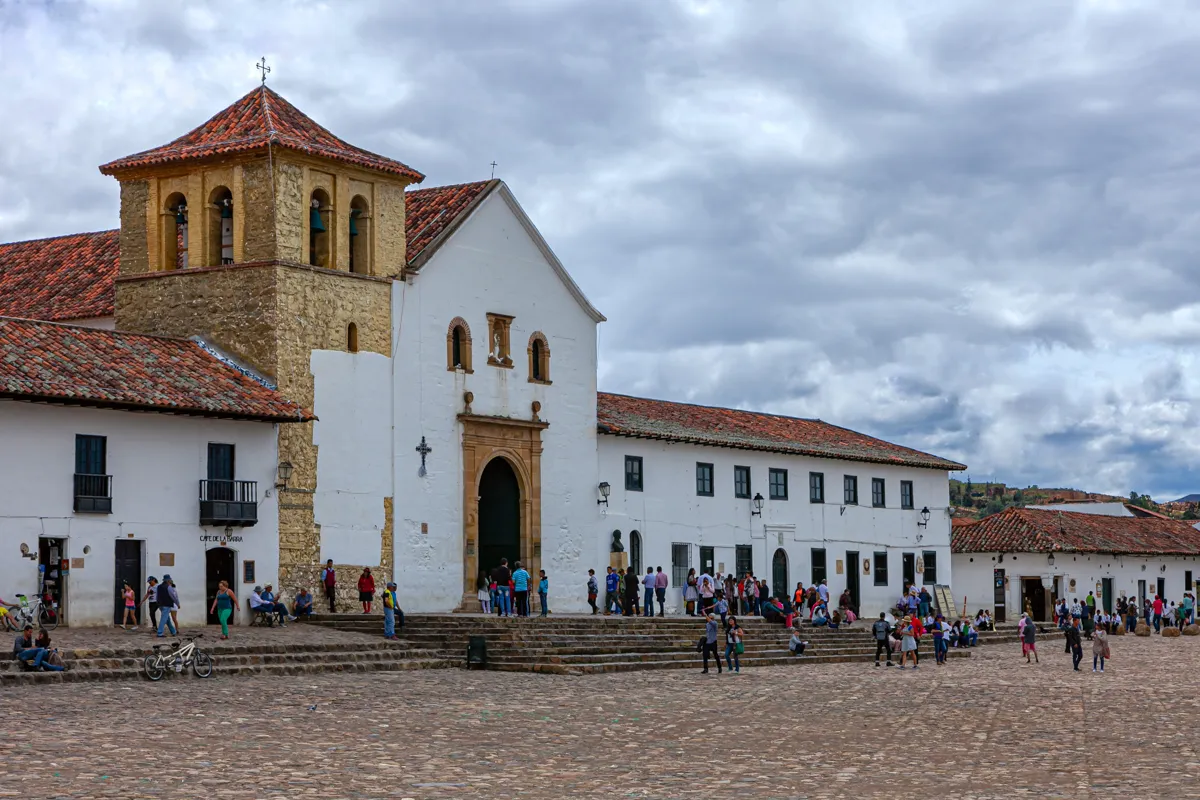
The first place you visit will be the town’s Plaza Mayor (central town square), which tells an intriguing story. At 120 meters on each side, it is the largest town square in Colombia and ranks among the largest squares in the Americas. Unlike typical Spanish colonial towns that built their plazas according to strict guidelines, Villa de Leyva’s square breaks all rules with its massive size. Local legend claims this was a deliberate act of rebellion by the town’s planners against Spanish crown regulations.
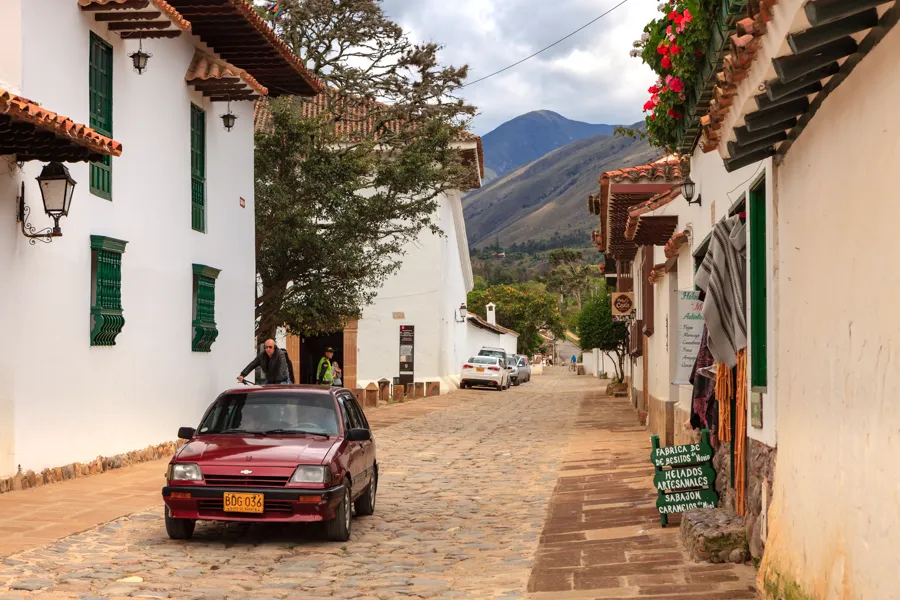 A cobblestoned carrera in Villa de Leyva © Mano Chandra Dhas
On this city tour, you’ll also visit Villa de Leyva’s Iglesia de Nuestra Señora del Rosario on the Plaza Mayor, a central piece of the town’s religious history. Built in 1608, the church’s elegant colonial architecture speaks of the town’s Spanish heritage. While its preserved interiors tell stories of centuries-old traditions. The charm of the town lies in these small, well-preserved details that make Villa de Leyva feel frozen in time.
After exploring the town and soaking in its historical charm, you’ll have the opportunity to indulge in a delicious lunch at one of the town’s quaint local restaurants (at your own expense). Your tour guide will be able to assist you in making your choice.
After lunch, you will have to make a choice. You either go to the Pozos Azules or choose to visit the Palaeontology Museum.
Mano’s Tip for Visitors
If I were to make a choice between the Pozos Azules and the Palaeontology Museum, to see the fossil of the Kronosaurus, I would choose the latter. It is a small museum and the main attraction is the fossil.
Nature’s Colour Palette – the Pozos Azules
After taking in the town’s rich core history, you can experience something entirely different, Villa de Leyva’s natural wonders. A short trip outside the town brings you to the man-made Pozos Azules (Blue Ponds). These striking ponds, with their turquoise hues, stand out against the dry, desert-like landscape. The ponds are a favourite spot for nature lovers and photographers alike, as the contrast between the greenish blue water and the surrounding earth creates a captivating scene.
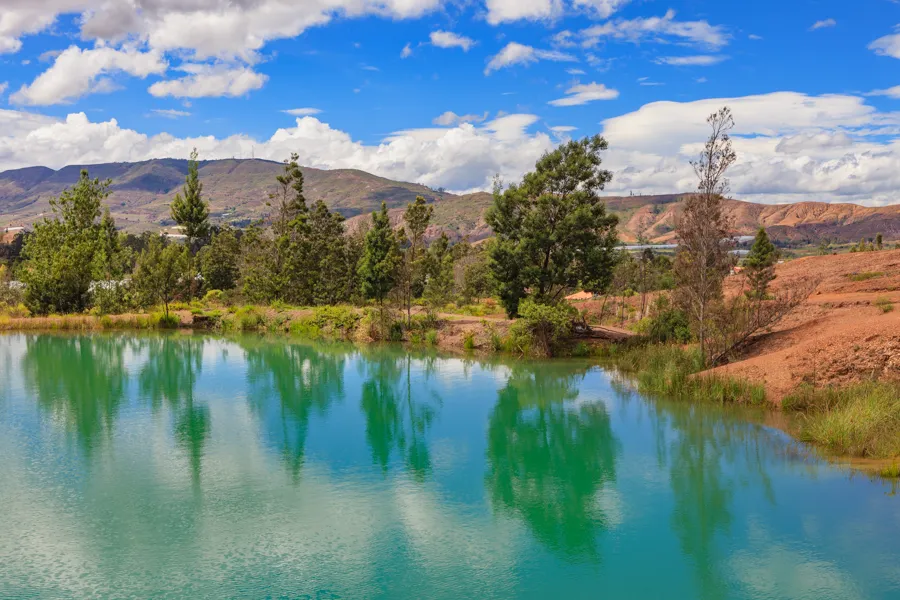 The Pozos Azules in VIlla de Leyva © Mano Chandra Dhas
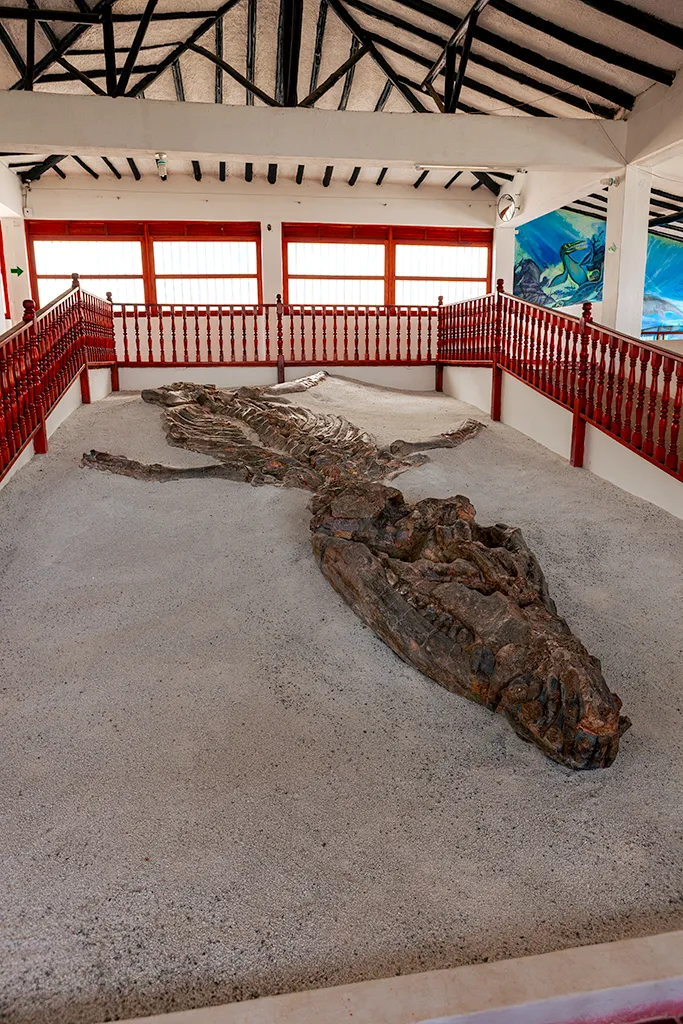 The fossil of the Kronosaurus Boyacensis in Sutamarchan © Mano Chandra Dhas
Visit the Kronosaurus
Perhaps the most fascinating chapter in Villa de Leyva’s history lies in its prehistoric past. This high-altitude town once lay at the bottom of a warm, shallow sea. For those interested in palaeontology a visit to the museum (optional), can be organised, to see the nearly complete fossil of the Kronosaurus Boyacensis. It offers rare insights into the Cretaceous period when the massive 7-metre-long marine predator was alive. The fossil was discovered in 1977 and dates back 120 million years.
Amateur palaeontologists still occasionally stumble upon ammonites and other fossils in the surrounding hillsides, reminding us that these peaceful mountain streets were once patrolled by some of Earth’s most formidable creatures.
Before the Spanish Conquistadores
The Muisca Legacy
The next stop of the city tour of Villa de Leyva, takes you back even further in time. Long before the Spaniards arrived, the local Muisca tribe had already recognised the valley’s special qualities. The indigenous Muisca civilisation left profound marks on the nearby landscape through their sacred sites and stone observatories.
At El Infiernito (Little Hell as named by the Spanish), rows of phallic-shaped stone columns stand in precise astronomical alignment. Spanish priests, horrified by these explicit symbols and the Muisca’s worship of the sun god Sue and moon goddess Chía, named it “Little Hell” and tried to suppress these ancient practices.
The site reveals the sophisticated knowledge of these pre-Colombian astronomers, who used these stone columns to track solstices and equinoxes. The Muisca aligned their agricultural cycles and religious ceremonies with celestial events, celebrating fertility and renewal through rituals that deeply disturbed the Catholic colonisers. Even today, the site stands as testament to a complex civilisation that Spanish missionaries tried but failed to erase from memory. Some present-day descendants of the Muisca still consider El Infiernito a sacred place, especially during solstices when the stones’ alignment with the sun holds special significance.
Tour Villa de Leyva - A Living Museum
Daily Life Trapped in History
Unlike many historical sites, Villa de Leyva pulses with real life. Local craftsmen work with centuries-old techniques, creating pottery and textiles in workshops that have operated for generations. The morning market fills with farmers selling fresh produce, their practices little changed from colonial times.
Return to Bogotá with Unforgettable Memories – Guaranteed!
After a day filled with history, nature, and adventure, your journey back to Bogotá provides time to reflect on all you’ve experienced. Villa de Leyva is more than just a beautiful colonial town, it’s a gateway to Colombia’s past, both natural and cultural. Whether you’re fascinated by ancient fossils or drawn to historical architecture, this destination leaves a lasting impression.
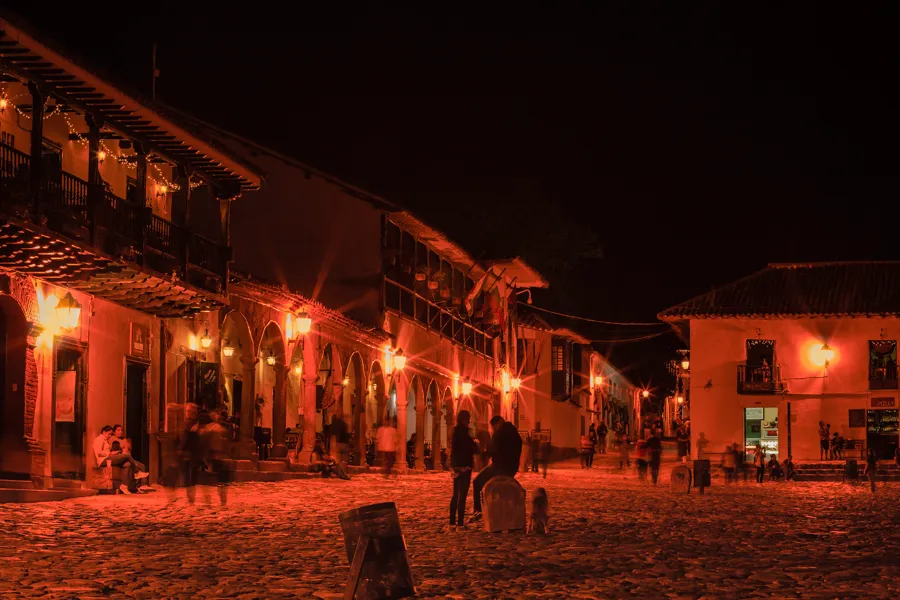 A corner of the main town square at night in Villa de Leyva, Colombia © Mano Chandra Dhas
Mano’s Tip for Visitors
The total travel time to and from Villa de Leyva for a day trip from Bogotá, could be well over 6 hours. That leaves you with limited time to really explore this fascinating town. With so much to see in and around the town, I’d highly recommend extending your stay to fully get to know all that this enchanting region has to offer. Consider at least an overnight stay.
What Will You See If You Extend Your Villa de Leyva Tour?
There’s no shortage of activities in and around Villa de Leyva. For nature lovers, the nearby natural parks offer excellent hiking opportunities, with scenic views of the surrounding landscape. You can also go horseback riding through the countryside, a peaceful way to explore the region. Birdwatchers will find plenty to marvel at, as the area is home to a variety of native species.
Wine enthusiasts will enjoy visiting local wineries to sample the region’s offerings. And for history buffs, more archaeological sites are waiting to be discovered just beyond the town.
For anyone seeking an escape from the fast pace of modern life, Villa de Leyva offers tranquility, beauty, and a deep connection to the past. It’s the perfect destination for history lovers, nature enthusiasts, and anyone looking for a unique adventure in Colombia.
Other Places and Activities of Interest in Villa de Leyva
Here below are some of the sites you can visit on on Day 2 if you decide to stay overnight in Villa de Leyva. There are several historical houses that are museums today.
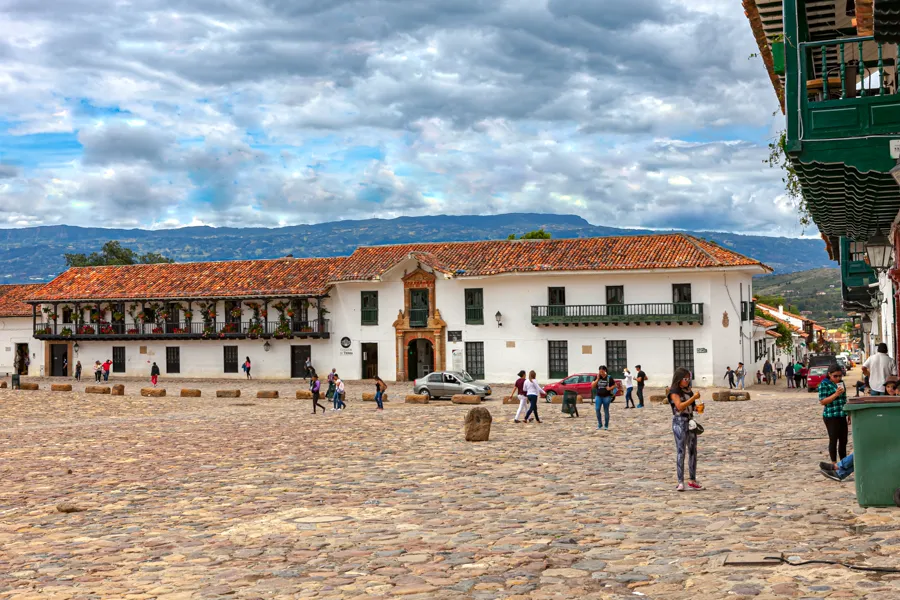 The Casa Museo Maestro Luis Alberto Acuña, in Villa de Leyva © Mano Chandra Dhas
Casa Museo Maestro Luis Alberto Acuña
The celebrated Colombian artist Luis Alberto Acuña lived in Villa de Leyva for the last 15 years of his life in the 20th Century. The house he lived in on the main town square is today a Museum. It houses several of his works of art.
Museo Casa Capitán Antonio Ricaurte
On the Parque Antonio Ricaurte in Villa de Leyva is the small house museum of the national hero Antonio Ricaurte. He lived in the house during his childhood days when the family moved to the town. Captain Ricaurte blew himself up when he lit a powder keg in San Mateo in today’s Venezuela to prevent the arms from falling into the hands of the Royalists. He is remembered for all time to come in the last verse of the Colombian national anthem. The house gives visitors an idea of how people lived in Colombia over 200 years ago.
Convento del Ecce Homo
Today, the Convento del Ecce Homo is a small museum 8 km away from Villa de Leyva. It started life as a Dominican Monastery back in 1620. Paved with stones quarried in the region, the stones in the Cloister here and there, contain ammonites and fossils. The builders even used some of them as decoration.
During the Wars of Independence, it was taken over and occupied by the army for 5 years. Then it became a school for a while. The Dominican friars recovered the premises in 1868. After the last friar passed away, it eventually became the museum it is today. It is a fascinating window into the 17th century: both life and architecture.
Scientific Legacy
Modern astronomers continue the area’s ancient tradition of stargazing. The clear mountain air and minimal light pollution make Villa de Leyva an ideal location for astronomical observation, linking present-day scientists with their Muisca predecessors who studied these same skies centuries ago.
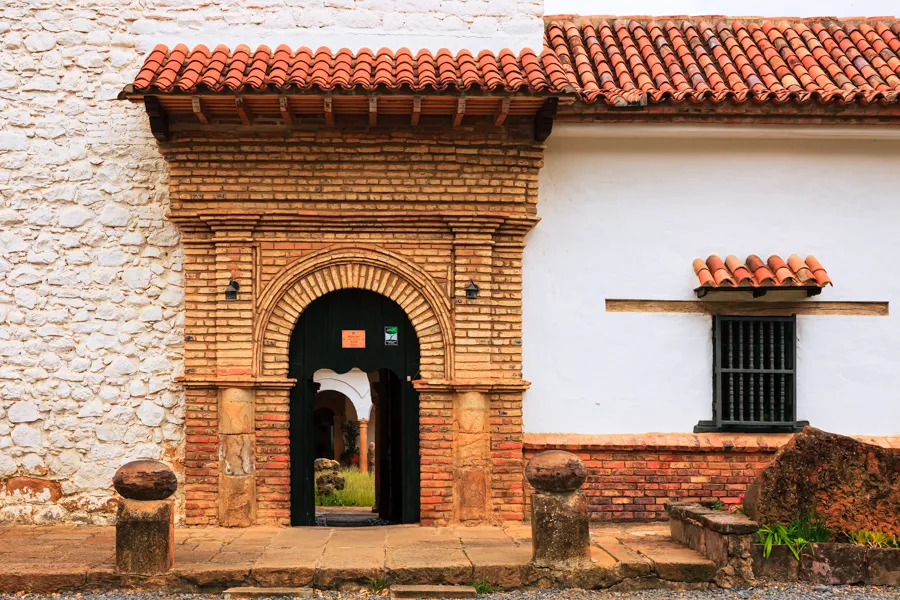 Convento del Ecce Homo in Sutamarchán © Mano Chandra Dhas
In Villa de Leyva, history isn’t confined to museums – it lives in every corner, every stone, and every tradition. While other colonial towns modernised, Villa de Leyva chose to preserve its past, creating a unique window into Colombia’s rich heritage. Visitors find themselves not just observing history but stepping into it, becoming part of a story that spans millions of years from prehistoric seas to the present day.
Festivals and Traditions
Villa de Leyva has its own calendar of festivals and events.
A Calendar of Celebrations
Villa de Leyva’s cultural calendar overflows with festivals celebrating everything from astronomy to onions. The Villa de Leyva Jazz Festival is held in July, followed by the Wind and Kite Festival in August. Participants prepare for the Kite Festival for many months. It also draws visitors from all over Colombia and other countries.
December’s Festival of Lights transforms the colonial centre into a wonderland of candles and paper lanterns. The International Tree Festival draws environmental activists and artists who create installations celebrating nature’s diversity.
There are many more festivals. Linking your visit with a festival that may interest you will require planning.
Gastronomic Heritage
The town’s culinary scene blends colonial Spanish influences with indigenous traditions. Local restaurants serve a hearty ajiaco soup alongside lesser-known Muisca-inspired dishes. The region’s unique climate allows for wine production, making it one of the few viable vineyard locations in Colombia.
Whether you choose to tour Villa de Leyva in a day, or two or three days, you cannot go wrong with a visit to this Colombian town that is frozen in time.
Summarised Itinerary
- 1
Departure from Bogotá
Early departure by private vehicle. The drive through the Andes to Villa de Leyva takes approximately 3.5 hours.
- 2
Plaza Mayor & town walk
Arrive in Villa de Leyva and take in the vast cobblestone plaza, the 16th-century church, and the whitewashed colonial architecture.
- 3
Ecce Homo Monastery
Visit the 17th-century Augustinian monastery, famous for its Mudéjar-style cloisters and well-preserved colonial chapel.
- 4
Lunch
Traditional Boyacá lunch at a local restaurant in Villa de Leyva (own account).
- 5
Pozos Azules & surroundings
See the striking blue mineral pools and the semi-arid landscape that makes the Boyacá region feel like a different world.
- 6
Return to Bogotá
Depart Villa de Leyva, arriving back in Bogotá approximately 20:00.
Please note: the order of stops and the timings shown are approximate and may change on the day for your safety and the best experience. See our Tour Terms & Conditions.
What's Included
- English-speaking certified guide
- Ecce Homo Monastery entry
- Private transport from/to your Bogotá hotel
Not Included
- Meals and drinks
- Gratuities
- Optional fossil museum entry
Frequently Asked Questions
Have a more general question about travelling with us? Visit our FAQs →
Let's plan your journey
Tell us what inspires you, and together we'll explore a journey that's just right for you.
Tour code:COBOG-VDL01
Available on request
No commitment required. We'll get back to you within 24 hours.