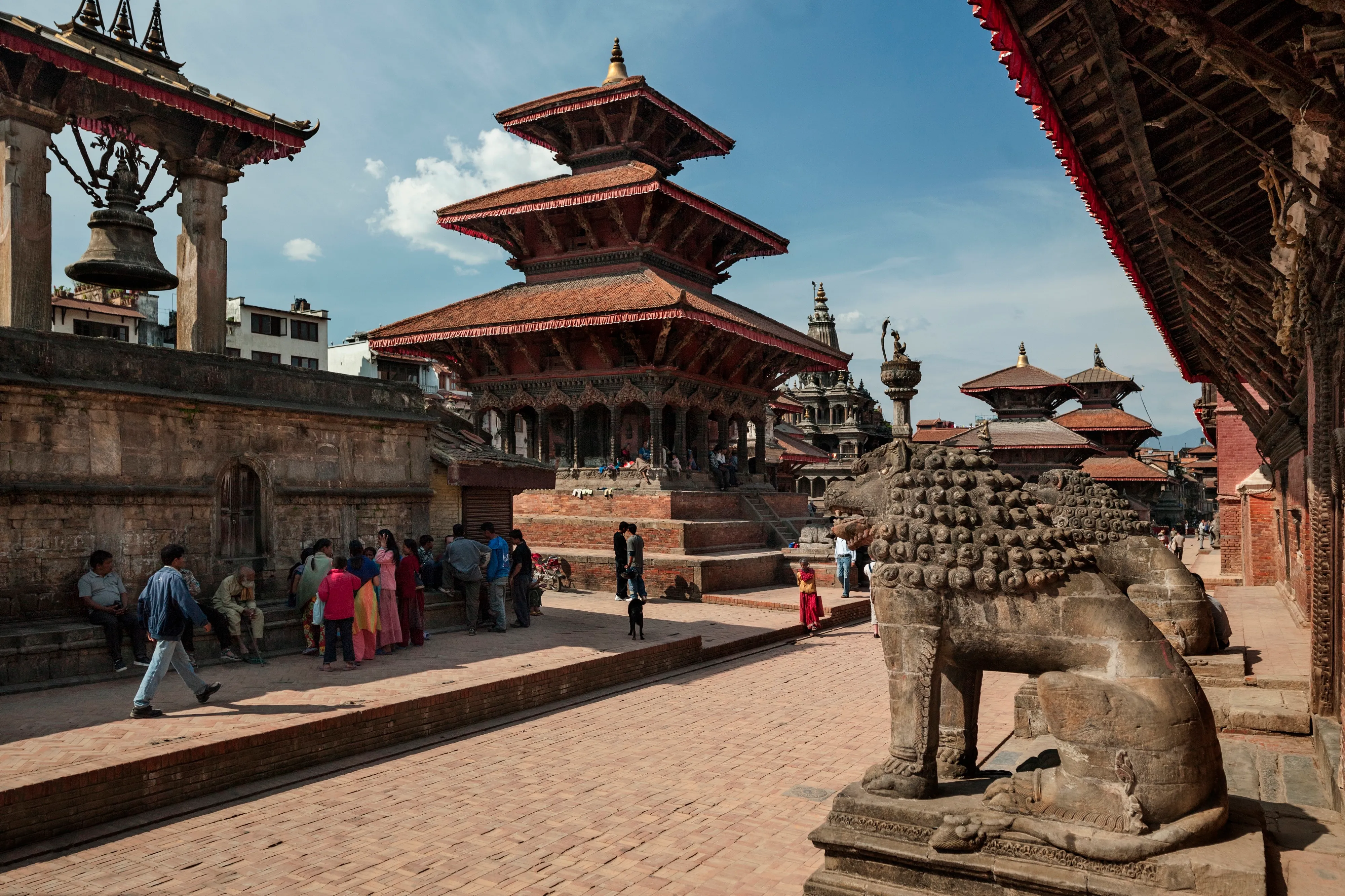
Valley of God and Goddess: Kathmandu Heritage
Tour Highlights
- All three valley Durbar Squares: Kathmandu, Patan, and Bhaktapur
- Sunrise from Nagarkot at 7,218 feet
- An hour of guided meditation at Namo Buddha monastery
- Changu Narayan Temple, dating from 464 AD
- Pashupatinath, Boudhanath, and Swayambhunath
Tour code
NPKTM-VGG01
Duration
10 days
Starting city
Kathmandu
Tour type
Private
Best season
Spring & Autumn
The Kathmandu Valley is one of the densest cultural landscapes in Asia. Three medieval cities sit within a single bowl of land, each with its own royal square, its own Newar architecture, and its own working pantheon of Hindu and Buddhist deities. Ten days is enough to see the major sites at a measured pace, with time to return to the ones that hold you.
A circuit, not a list
The route is structured as a circuit rather than a checklist. Kathmandu’s own Durbar Square and the nearby temples of Dakshinkali and Sheshnarayan come first, then a full day in Patan among the bronze workshops and the Golden Temple. From there the itinerary moves out to Changu Narayan, up to Nagarkot for a sunrise, down into Bhaktapur for an overnight in the old quarter, and on to Namo Buddha for an hour of guided meditation at the monastery. Pashupatinath, Swayambhunath, and Boudhanath close the loop.
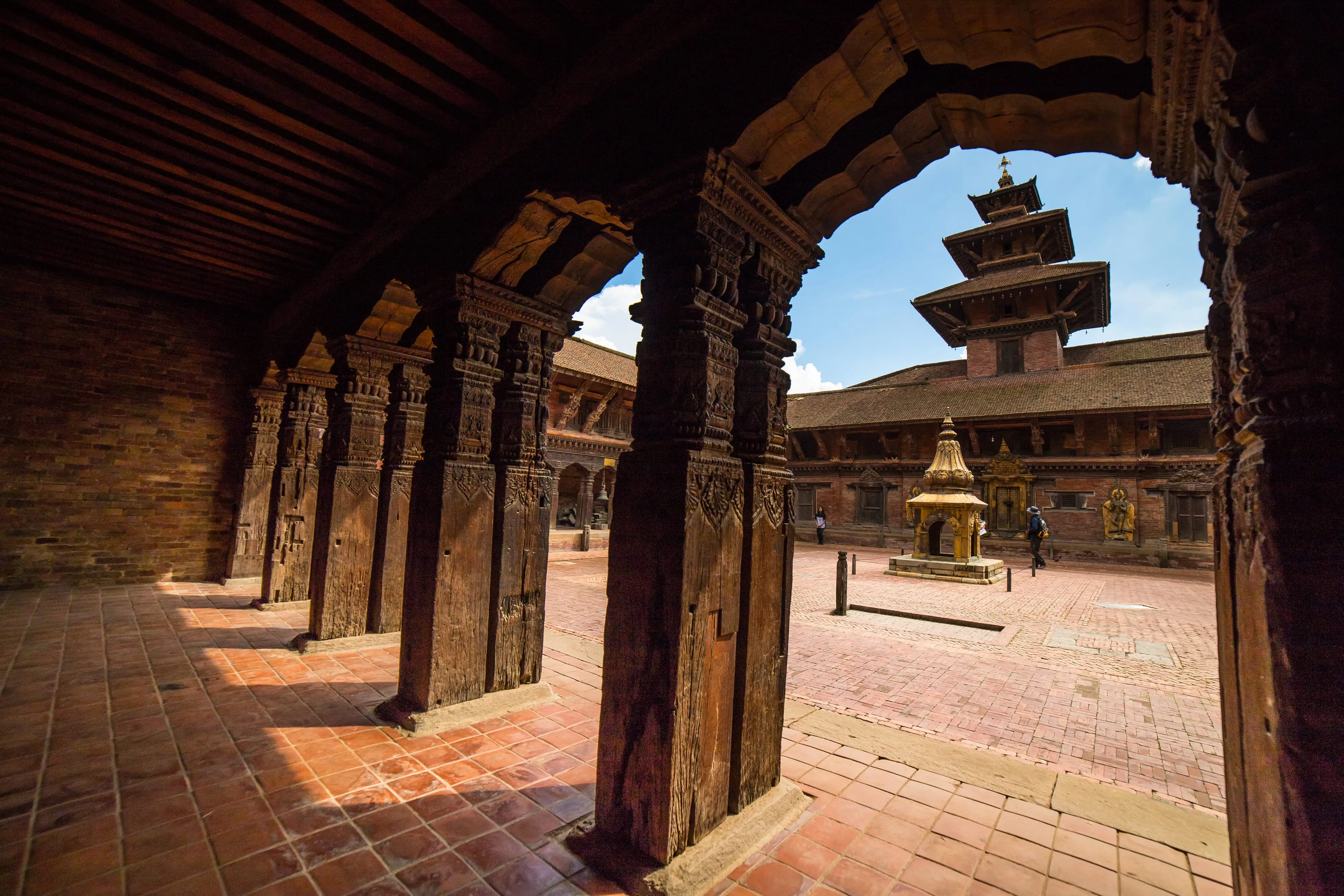 Patan Durbar Square, the City of Fine Arts, Kathmandu Valley
What it feels like on the ground
Mornings start early to catch sites at their quietest: Budanilkantha at the 07:30 puja, Pashupatinath before the cremation ghats fill, Swayambhunath as the monkeys are still settling. Afternoons tend to involve walking on uneven stone paving and a fair amount of standing. The pace is steady rather than rushed.
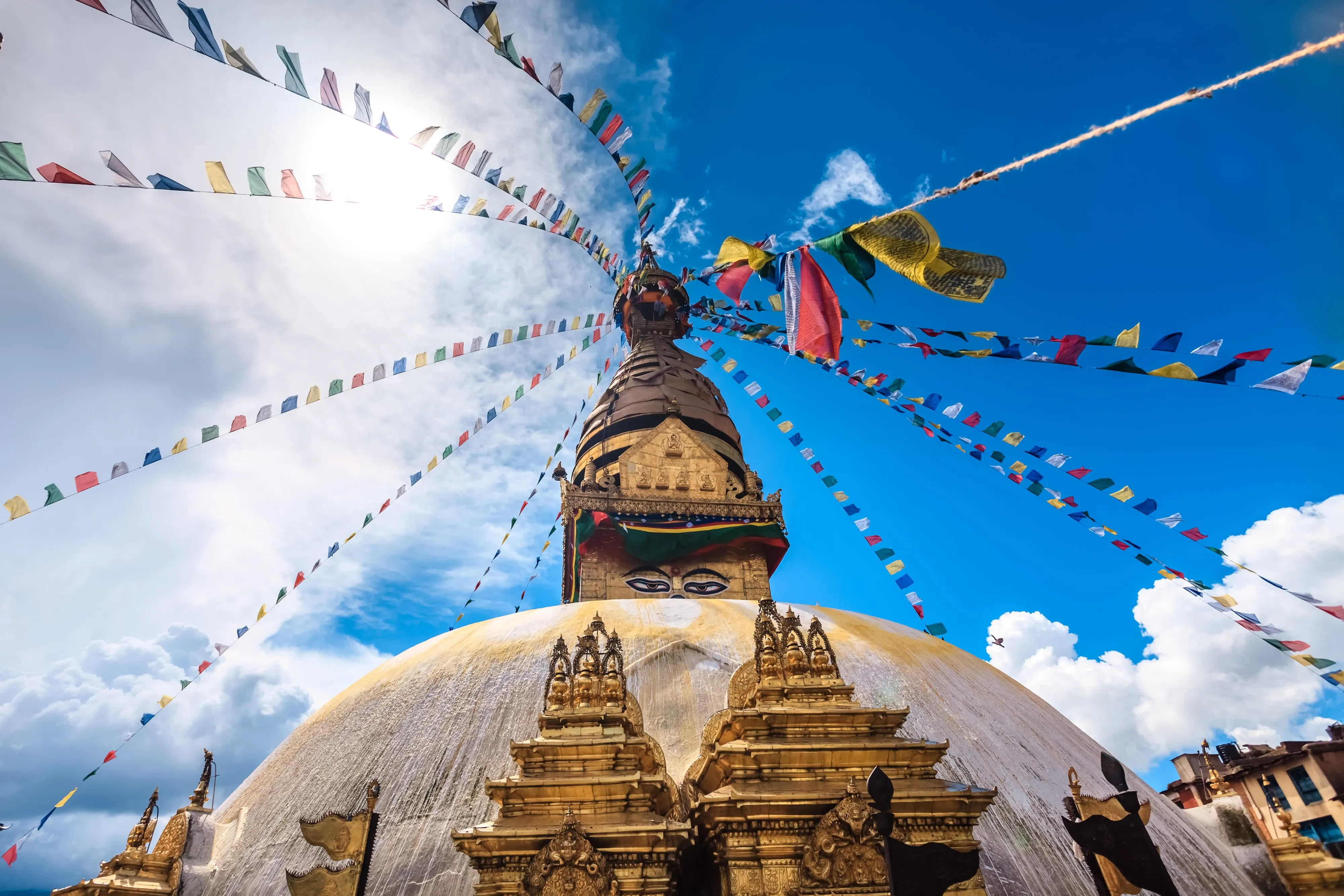 Boudhanath Stupa, sometimes called Mini Tibet, Kathmandu Valley
Practical notes
No specific fitness is needed beyond an ability to walk three or four hours a day on uneven ground. Altitude is not a factor: Kathmandu sits at around 4,600 feet, Nagarkot at 7,218 feet. The clearest seasons are autumn and spring; the monsoon months from June to August can obscure mountain views from Nagarkot entirely.
Itinerary
- 1Day 1
Arrival in Kathmandu
Arrival at Kathmandu international airport, where you are received and transferred to the hotel. Check in with a warm welcome drink, followed by a briefing of the entire package by the tour officer. Overnight at the hotel.
- 2Day 2
Kathmandu Durbar Square and Dakshinkali
Breakfast at 0700 and a walking tour from 0900 to Kathmandu Durbar Square. The morning takes in the Vishnu Temple, Akash Bhairav, Kal Bhairav, Swet Bhairav, the Virgin Goddess Kumari, Ganesh Mandir, Nasal Chowk, Hanuman Dhoka, and Gaddhi Baithak.
After lunch, drive to Dakshinkali, one of the principal temples in Nepal dedicated to the fierce mother goddess Kali. On the return, stop at Sheshnarayan Temple, one of the four Narayan temples of the Kathmandu valley. Back to the hotel.
- 3Day 3
Patan, City of Fine Arts
After breakfast, a full sightseeing day in Patan, the City of Fine Arts. Begin with the Sundari Chowk galleries, famous for the elaborately engraved Tusha Hiti water spout. It is said the king meditated on the stone platform before the Tusha Hiti as a demonstration of devotion and will power.
Continue to Keshav Narayan Chowk, home to a small shrine to Keshav Narayan and to the Patan Museum collection. Then Mulchowk, the oldest courtyard in the palace complex, with its two towering temples of Taleju and Agamveda and a central shrine to Yantaju.
Visit the twelfth century Golden Temple, the most beautiful in all the Kathmandu valley. King Bhaskar Verma is said to have had a divine dream that inspired him to found a temple at the palace, where he saw a golden rat chasing a black cat. Close at the Baglamukhi Temple, a Shakti peetha of Ma Baglamukhi, worshipped for power, victory, and protection from cuts, scars, operations, and accidents. Back to the hotel.
- 4Day 4
Changu Narayan and Nagarkot
After breakfast, drive to Changu Narayan Temple, which holds a remarkable collection of statues and sculptures and is famous for its craft in wood, stone, and metal. Garuda, half man and half bird, is the vehicle of Vishnu, and the temple is decorated with the ten incarnations of the Narayan. It dates back to 464 AD.
A one-hour hike then descends to Teel Cot, where your vehicle waits to take you on to Nagarkot. Check in at the hotel, set at 7,218 feet above sea level. Overnight at Nagarkot.
- 5Day 5
Sunrise at Nagarkot, on to Bhaktapur
Sunrise over the Himalayan range from Nagarkot. After breakfast, a short drive takes you to Bhaktapur, the former royal capital nicknamed the city of devotees and a genuine medieval town. Also known as Bhagdaon, it is undoubtedly the most beautiful city in the Kathmandu valley because it has kept its medieval appearance intact.
Visit the eighteenth century Natyapola Temple, dedicated to the goddess Siddhi Lakshmi, an incarnation of the goddess Parvati. Continue to the Bhairavnath Temple, Taleju Bhawani Temple, Dattatreya Temple, Wakupati Narayana Temple, Indrayani Temple, and Siddhi Lakshmi Temple. Overnight in Bhaktapur.
- 6Day 6
Namo Buddha and Panauti
After breakfast, drive to Namo Buddha, a Buddhist pilgrimage site associated with Prince Mahasattva, believed to be one of the former incarnations of Buddha Shakyamuni. Walking in the forest with his brothers, the prince encountered a hungry tigress close to death and unable to feed her cubs. His brothers went away, but in an act of compassion he gave himself to the tigress and transported her to higher realms of existence. When his brothers returned, they found only bones and hair. The stupa is said to have been built on those remains. An hour of guided meditation and Buddhist puja follows at the monastery.
Continue to Panauti, set at the confluence of the Roshi and Punyamati rivers and believed to be founded on a single rock. It is a historical Newar town, one of the oldest in the Kathmandu valley. A month-long festival is held once every twelve years at Triveni Ghat, where three rivers meet: the Roshi, the Punyamati, and the Lilawati. Panauti, or Panoti, is also the name of the goddess of troubles. Drive back to Kathmandu.
- 7Day 7
Budanilkantha and Swayambhunath
Before breakfast, at 0700, a twenty-minute drive to Budanilkantha to see the Sleeping Vishnu, a five-metre granite image carved from a single rock. The Vishnu puja begins at 07:30, performed by batuks under twelve years of age. The site is a living archive of spirituality and history. Return to the hotel for breakfast.
At 1300, visit Swayambhunath Stupa, the self-arisen. The stupa is said to have risen spontaneously from a lotus seed planted on the lake by Vipaswi Buddha of a past eon as Dharmadhatu, the flame of wisdom. Whether or not you carry that story with you, the place has a quality of accumulated devotion that is hard to account for by the architecture alone. Back to the hotel.
- 8Day 8
Pashupatinath and Boudhanath
At 0830, visit Pashupatinath, the only Hindu temple of its kind in the world and the most revered place in Nepal, often called the small Benares with its ghats and its many Hindu ascetics, the sadhus. Only Hindus may enter the inner temple, which is dedicated to Lord Shiva. The pagoda-shaped roof is made of gold and silver, and the entrance doors are also of gold and silver. Inside the enclosure, a gigantic silver statue of Nandi, the bull mount of the god, stands before the temple.
On the banks of the Bagmati you will see cremation according to Hindu tradition: the body is dipped three times into the river before cremation so that the cycle of reincarnation may be brought to an end. From there, climb the hill to the temple of Gorakhnath, then descend to the Guheswari Temple, adi shakti.
Drive on to Boudhanath, sometimes called Mini Tibet. The first stupa was built after AD 600, when the Tibetan king Songtsen Gampo converted to Buddhism. Return to the hotel.
- 9Day 9
Free day in Kathmandu
After breakfast, the day is free for individual activities and shopping.
- 10Day 10
Departure
After breakfast, free time until the transfer to the airport for onward travel.
Please note: the order of stops and the timings shown are approximate and may change on the day for your safety and the best experience. See our Tour Terms & Conditions.
What's Included
- One night in Nagarkot with dinner and breakfast
- One night in Bhaktapur with breakfast
- All transfers by private vehicle
- Monument entry fees
- English-speaking guide throughout
- One bottle of mineral water per person per day
- Seven nights three-star hotel in Kathmandu with breakfast
Not Included
- Personal travel insurance
- Anything beyond the itinerary
- Tipping
- Nepal visa fee
Frequently Asked Questions
Have a more general question about travelling with us? Visit our FAQs →
Let's plan your journey
Tell us what inspires you, and together we'll explore a journey that's just right for you.
Tour code:NPKTM-VGG01
Available on request
No commitment required. We'll get back to you within 24 hours.