Most journeys through India are measured in cities. You arrive, you see, you move on, and the shape of the trip is the line drawn between the places on the map. A week in Rishikesh works differently. The measure is the day itself, and the day has the same three parts every time: a morning on the mat, a day among temples and the river, and an evening at the water’s edge as the lamps are lit.
That rhythm is the reason we have added a yoga journey to Rishikesh to our India collection, and it is worth explaining what the week actually feels like before anyone decides whether it is for them.
Why Rishikesh Holds the Title
Rishikesh sits in the foothills of the Himalayas at the point where the Ganges leaves the mountains and begins its long journey across the plains. It is known internationally as the Yoga Capital of the World, and its ashrams, Parmarth Niketan among the best known, draw people from all over the world to practise beside the river.
Its fame in the West has a more recent origin. In 1968 the Beatles came to Rishikesh to study meditation at the ashram of Maharishi Mahesh Yogi, and wrote a large share of the songs that became the White Album while they were there. That ashram, now known as the Beatles Ashram or Chaurasi Kutia, stands abandoned by the river, its meditation halls covered in artwork, and it is one of the visits on the fifth day.
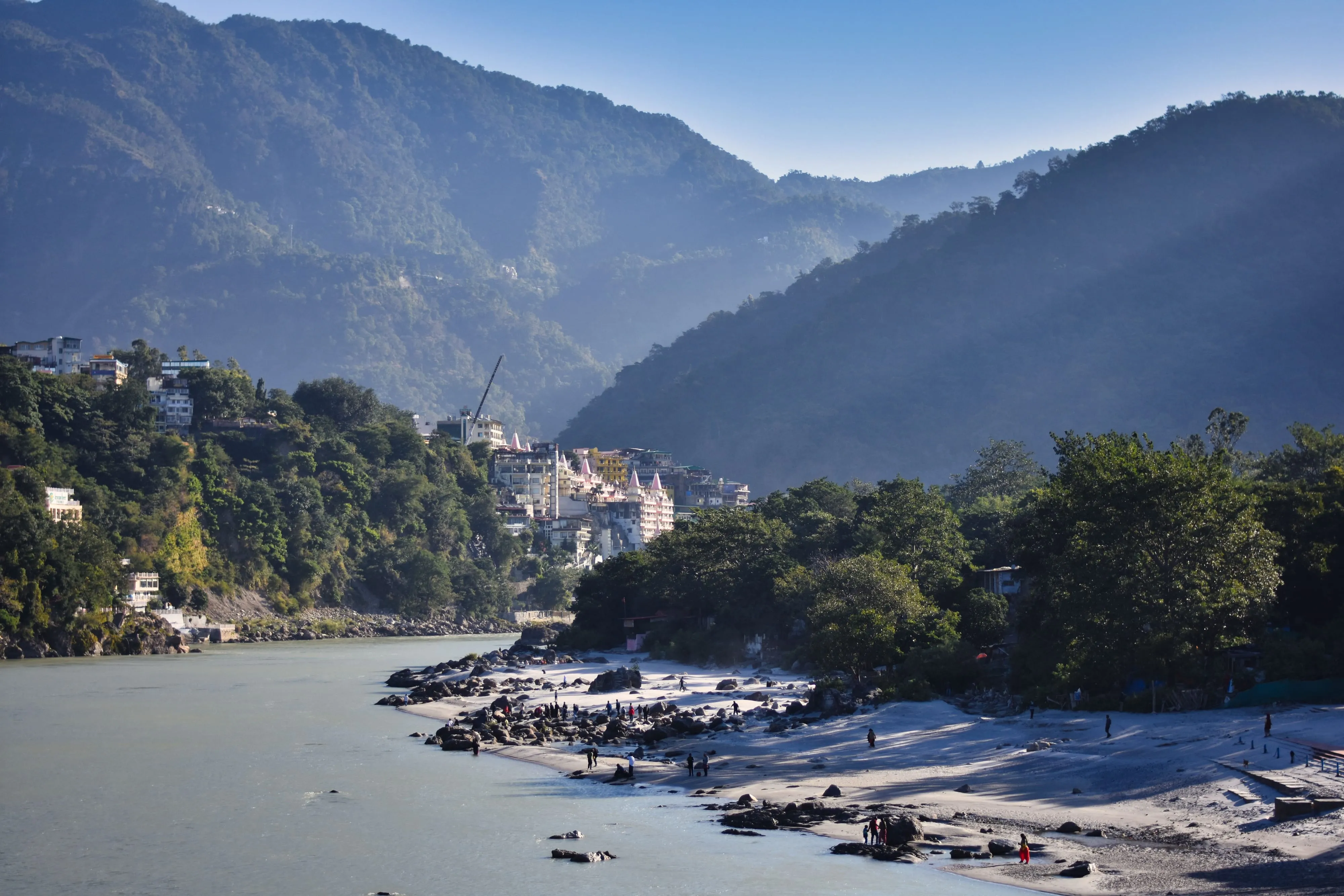 The Ganges at Rishikesh, where the river leaves the Himalayan foothills behind and turns towards the plains.
The Morning: Five O’Clock on the Mat
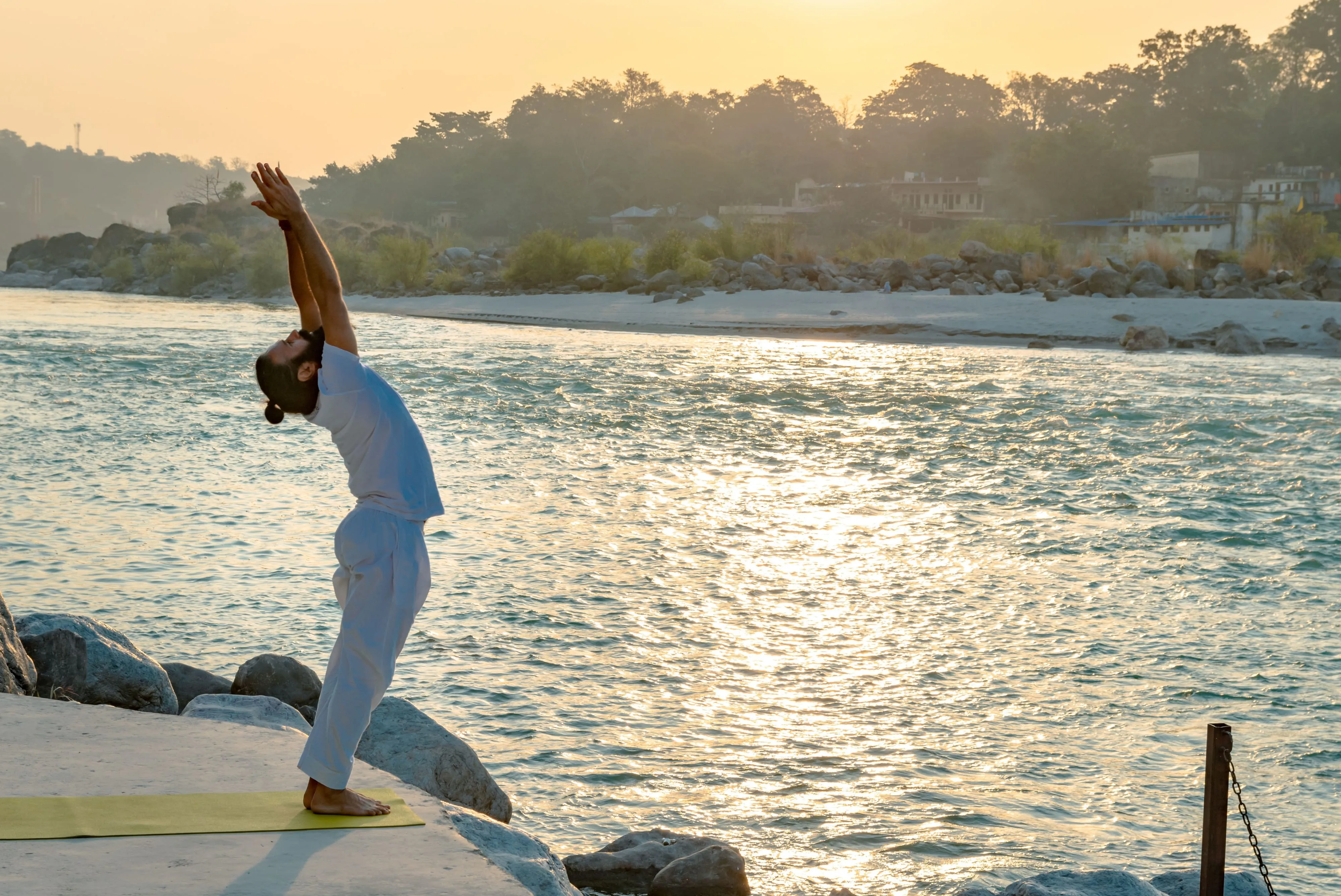
Each morning in Rishikesh, from the fourth day to the eighth, begins with a one-hour yoga session at five o’clock, led by a yoga instructor. That is early, and deliberately so. The hour before breakfast is the quietest of the day, and practising then means the rest of the day is free for everything else, with nothing to fit around.
Five mornings is a meaningful number. A single class is a taste; five consecutive mornings start to become a routine, and a routine is what most people who come to Rishikesh for yoga are actually looking for. It is enough time for the body to settle into the hour, and for the hour to become the part of the day you look forward to.
The Day: Temples, Hills, and the Rivers That Make the Ganges
After breakfast the week opens outwards. The first full day stays in town: across the Ram Jhula suspension bridge, through Parmarth Niketan Ashram, and up the many storeys of the Trayambakeshwar Temple. On later days the drives climb into the hills, to Kunjapuri Temple at around 5,500 feet, where the view takes in the Himalayan range and the whole of the Doon Valley, and to Neelkanth Mahadev, a pilgrimage temple dedicated to Shiva.
The longest day goes upstream to Devprayag, about two and a half hours away, where the Bhagirathi and the Alaknanda meet. Below the confluence the river takes the name Ganga. Standing at the point where the river everyone has heard of actually begins is a quiet and rather moving thing, and it gives the whole week a sense of geography: every Ganga Aarti on the tour is performed on water that has passed this spot.
The Evening: Three Ganga Aartis, Three Characters
The Ganga Aarti is the ritual offering of fire and light to the river at dusk, with priests raising lamps while hymns are sung. The tour attends it three times, and each one is different.
The first is at Triveni Ghat in Rishikesh on the fourth evening, hundreds of lamps and devotional singing as the sun goes down. The second, two nights later, is at Parmarth Niketan Ashram, more tranquil, carried by Vedic chanting. The third is the grandest: Har Ki Pauri in Haridwar, the city known as the gateway to the gods, where it is worth arriving early to find a place before the priests begin.
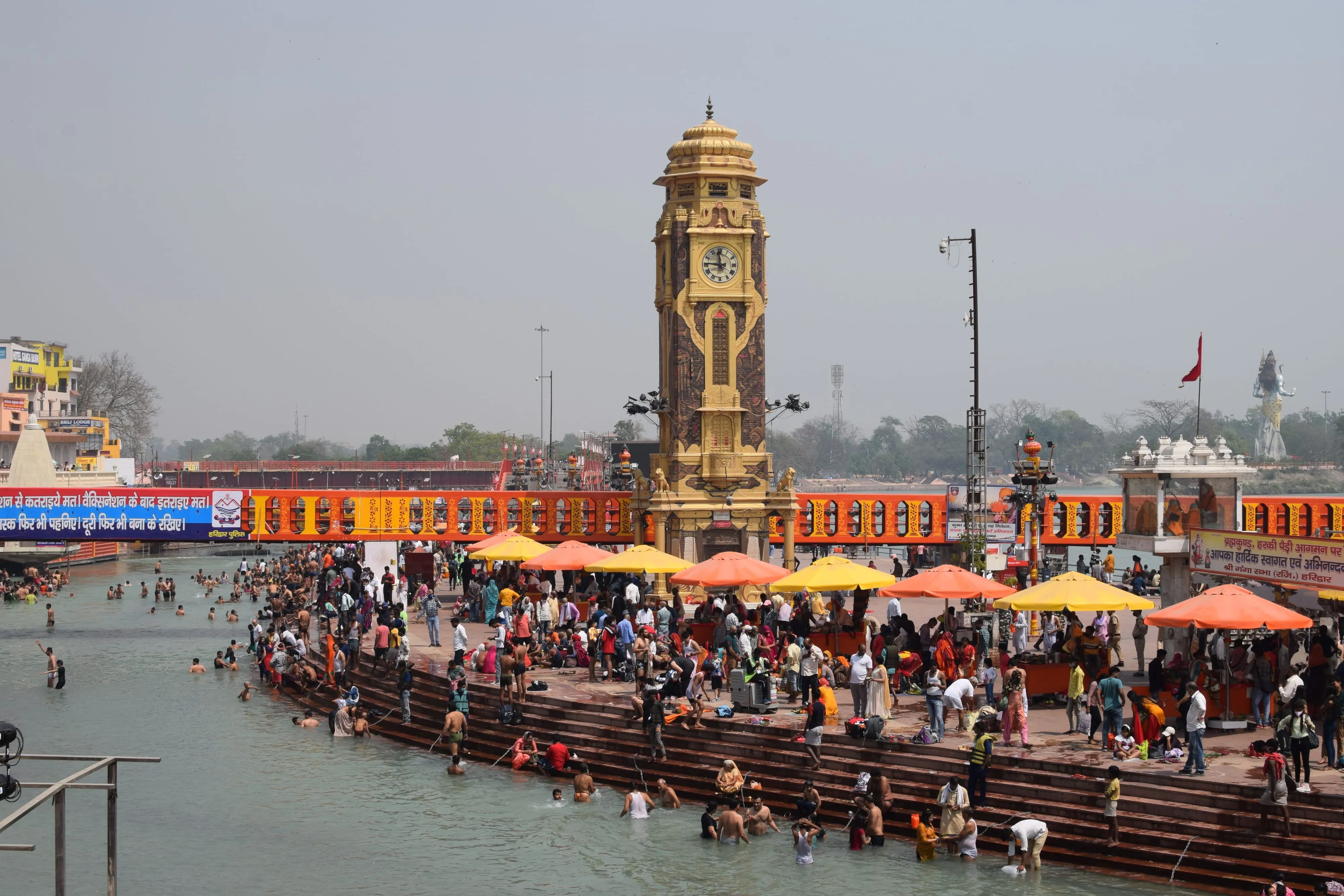 Har Ki Pauri in Haridwar by day. At dusk the same steps fill for the largest of the three Ganga Aartis on the tour.
Seeing the same ceremony in three settings is one of the quieter strengths of the week. The first time, everything is new and slightly overwhelming. By the third, you know what is coming and can simply watch.
Why We Chose This Shape
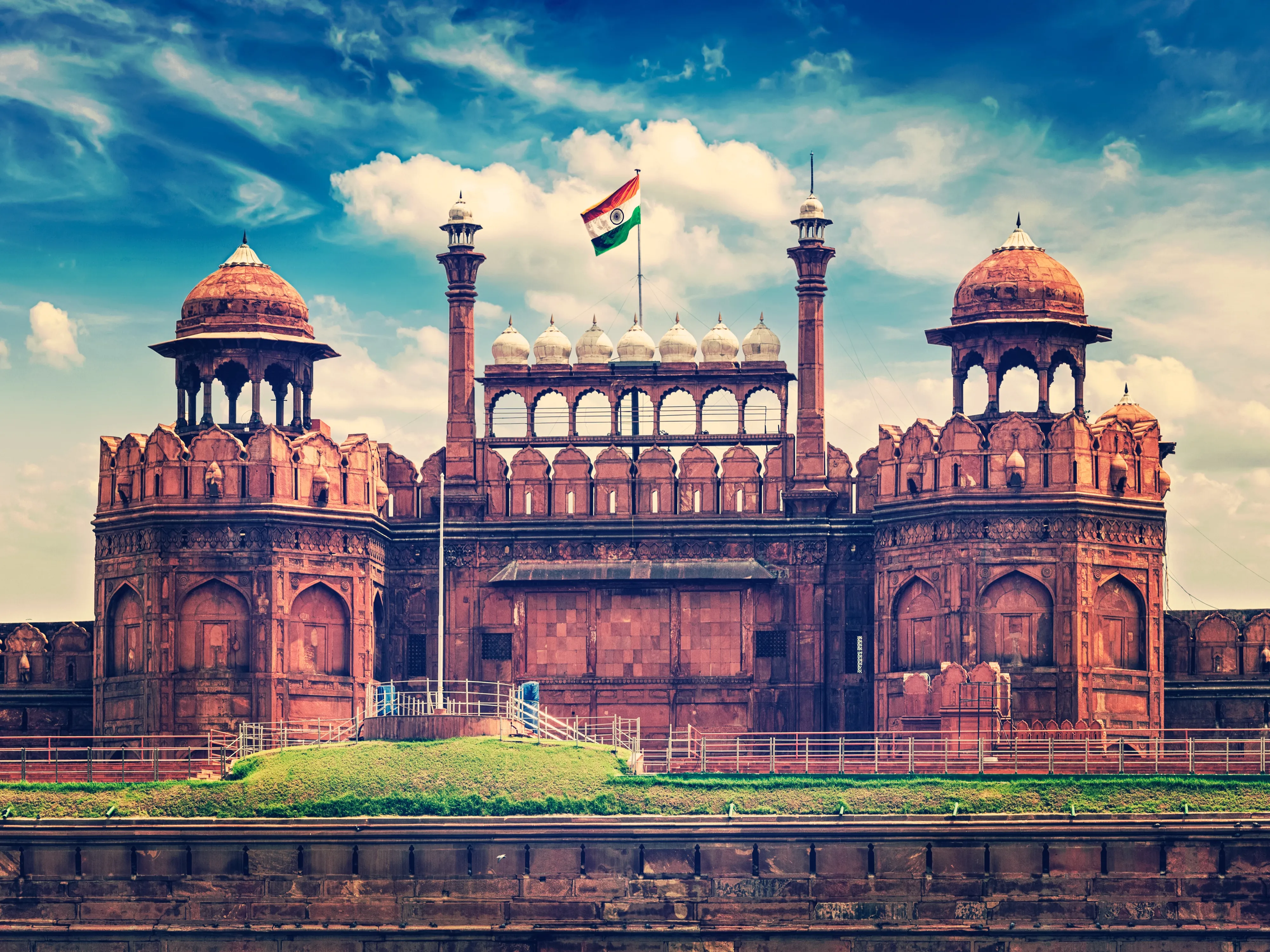
The tour opens and closes in Delhi, with a city day at the start that engages the senses in its own way: Humayun’s Tomb, a rickshaw through Chandni Chowk, a perfume workshop in an eighth-generation ittar studio, and the calm of Jama Masjid and Gurudwara Bangla Sahib. Getting to Rishikesh is by train to Haridwar and a short drive, rather than a long day on the road.
What appeals to us about this itinerary is that it asks so little of the traveller in logistics. Six nights in Rishikesh means one place to unpack, one riverside to get to know, and days that grow from a fixed point rather than a schedule of check-outs. For travellers who want India at a walking pace, with something real at its centre, that is a rare thing to find in a ten-day trip.
If a week of mornings on the Ganges sounds like the trip you have been looking for, tell us when you would like to travel and we will shape the rest of it around you.

Written by
Mano Chandra Dhas ›Founder of Coromandel Tours. In travel since 1975, from Singapore Airlines to Emirates and Carlson Wagonlit, he now curates private journeys through Colombia, Peru, India, and Nepal from his home in Bogotá. Many of the photographs on this site are his.