There is a particular moment on a first visit to Medellín when the city stops being a list of things to do and starts making sense as a place. For most people it happens on the Metrocable, somewhere above the rooftops, when they realise that the cabin they are riding in is full of people going home from work.
That is the thing worth understanding about Medellín before you arrive. Its transport system is not a novelty laid on for visitors. It is the most legible piece of what the city did to itself over the past thirty years, and it is the reason a traveller can spend a week here and come away with a genuine sense of the place rather than a set of photographs.
The Valley Set the Problem
Medellín fills the Aburrá Valley at roughly 4,900 feet. The floor of the valley is flat and narrow and holds the centre, the business districts, and the main road and rail corridor. The walls rise steeply on both sides, and over decades they filled with neighbourhoods, many of them built by people arriving from the countryside, in places the road network never properly reached.
That is a geography problem with a social consequence. A neighbourhood you cannot easily leave is a neighbourhood you cannot easily work in, study in, or be governed from. Distance measured in miles was trivial. Distance measured in hours was not, and it fell entirely on the people least able to absorb it.
The Cable Cars Were the Answer, and They Were Not Built for You
The Metrocable was the response, and the thing to hold on to is that it was built as ordinary public transport for those hillside neighbourhoods. Not as a viewpoint, not as an attraction, but as a way of connecting the valley walls to the valley floor and to the metro running along it. Our Medellín city page puts it plainly: the cable cars now carry residents and visitors alike, and the emphasis belongs on the residents.
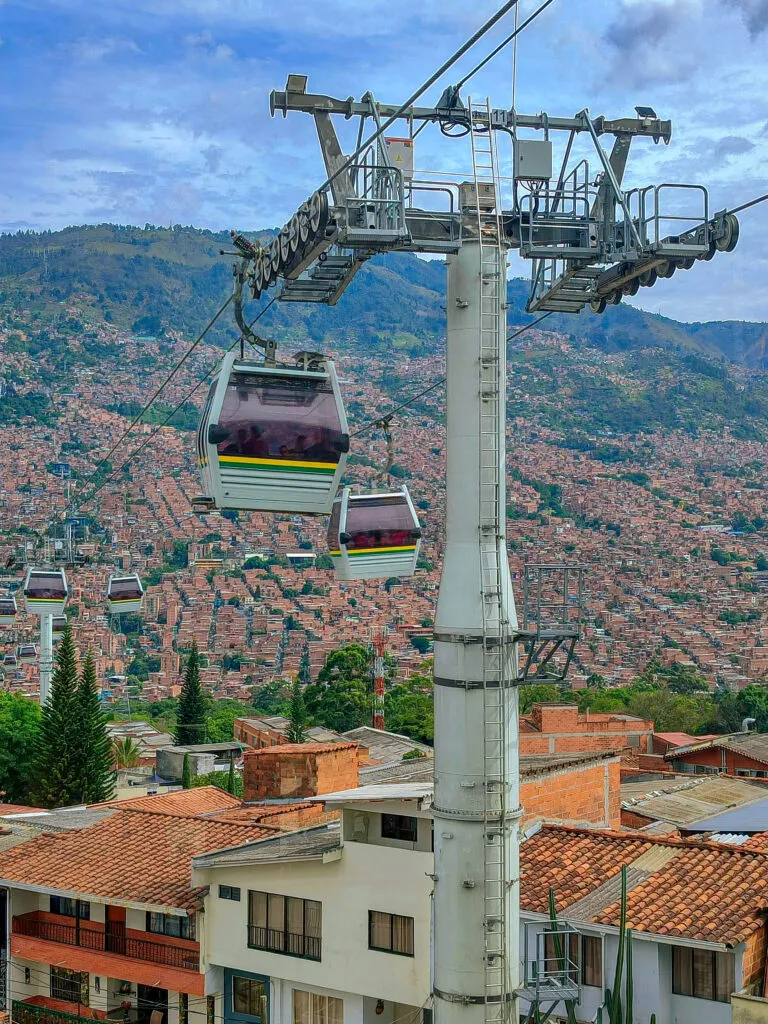 The Metrocable above the rooftops. A commuter service that happens to have the best view in the city.
This is why the ride is worth taking properly rather than as a quick up and down. The view changes as you climb, from dense brick housing below, through green ridges, to quiet upland parks at the top, and what you are actually watching is the gradient of the city laid out in order. The “We Don’t Talk About Pablo” city tour builds the Metrocable into its four hours for exactly this reason, and describes the system, accurately, as a transformative piece of urban infrastructure rather than a ride.
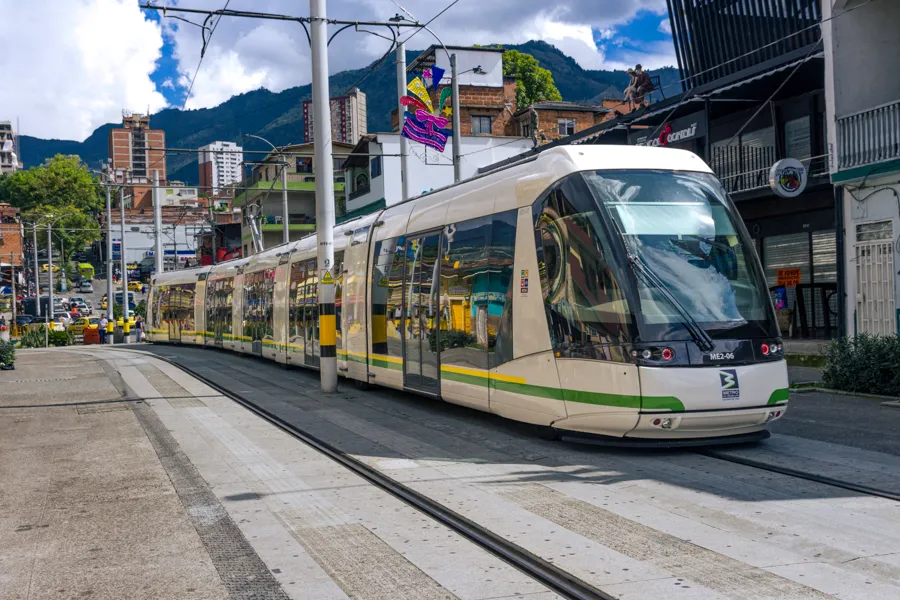
The same logic produced the rest of it. Comuna 13, once one of the most difficult neighbourhoods in the city, is now reached by outdoor escalators running up the hillside, and carries some of the best street art in South America. Libraries were built into the poorer barrios rather than in the comfortable parts of town. The tram runs at street level through neighbourhoods that the metro line does not serve. In each case the same idea: put good public infrastructure where the need is greatest, and treat that as the point rather than as charity.
None of this makes Medellín a solved city, and it would be a disservice to suggest otherwise. What it makes Medellín is one of the most studied examples of urban renewal in Latin America, and unusually, a place where you can see the argument for yourself from a cable car window for the price of a metro fare.
What This Means for Your Days
The practical consequence is simple, and it is the reason this is worth a whole article rather than a footnote. In most cities, public transport is how you get between the things you came to see. In Medellín it is substantially one of the things you came to see, and treating it as transport rather than as an attraction is the way to get the most out of it.
So ride the metro between neighbourhoods instead of taking taxis everywhere. Take the Metrocable at a normal hour rather than only at sunset, when it is doing its actual job. Let the tram carry you through a part of the city that is not on any itinerary. None of this costs an afternoon, because you were going to be travelling between places anyway. It only requires deciding to pay attention on the way, which is the slow travel argument applied to a commute.
It also tells you something about which neighbourhoods are reachable and therefore which days make sense. A city where the hillsides are connected is a city where you can plan an afternoon in a barrio well away from the tourist circuit and get back without a negotiation, which is the assumption sitting quietly underneath everything worth doing in Medellín.
There is a version of a Medellín visit that stays in El Poblado, moves by taxi, and comes home having seen a pleasant, mild-weathered city with good restaurants. It is not a bad trip. It is just a much smaller one than the city is offering, and the difference between the two is mostly a matter of what you decide to get on.
If you would like the shape of a few days here worked out properly, tell us what you have in mind and we will be straight with you about what fits.

Written by
Mano Chandra Dhas ›Founder of Coromandel Tours. In travel since 1975, from Singapore Airlines to Emirates and Carlson Wagonlit, he now curates private journeys through Colombia, Peru, India, and Nepal from his home in Bogotá. Many of the photographs on this site are his.