There is no experience in Colombia that parallels walking through time in Bogotá’s La Candelaria district. North, South, East or West, you will meet head-on with history. Every stone will tell you stories of the past. Within a radius of about 1 to 1.5 miles, there is more history compacted than in the rest of Colombia.
Walking is the Only Way to Experience La Candelaria
La Candelaria, Bogotá’s historic centre, holds within its colonial Carreras and Calles the echoes of Spanish conquistadors and independence fighters mingled with the mundane facade of modern everyday life. As you walk these paths, you’re literally stepping where Simón Bolívar once strode, where Vice-royalty carriages once clattered, and where the first whispers of independence were exchanged in hushed colonial courtyards.
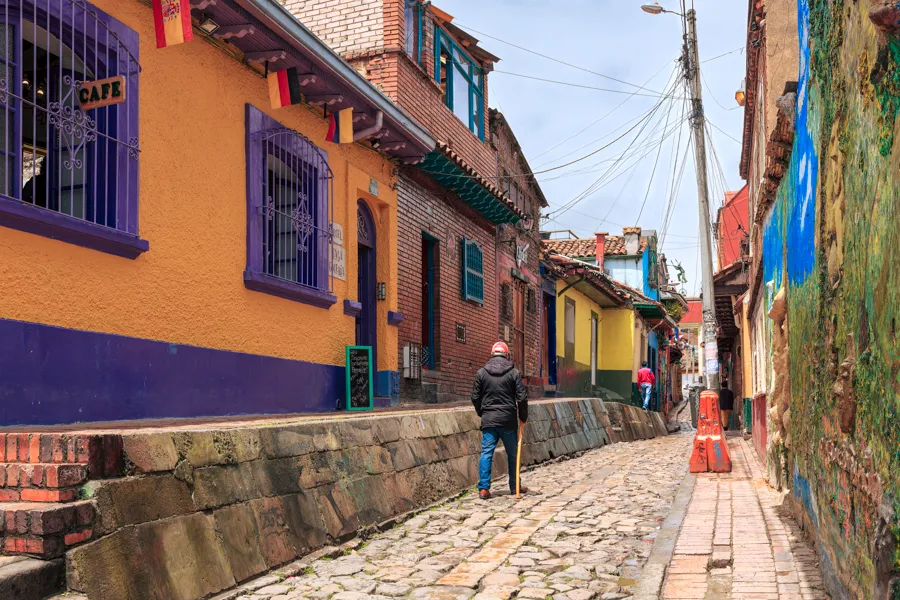
La Candelaria - Calle de Embudo
The Intimate Connection Between Feet and History
The very cobblestones beneath your feet were laid by indigenous hands in the 16th century, each one telling a story of colonial rule and rebellion. The rhythm of your footsteps matches those of centuries of wanderers – from Spanish nobles in their fineries to modern-day artists who’ve transformed this district into a canvas of cultural expression.
The Hidden Treasures Only Walkers Discover
Architectural Details Up Close
Walking reveals the layers of history in every facade – from the austere Spanish Colonial structures to the flamboyant Republican-era buildings. You can trace your fingers along walls where the patina of time has left its mark, or pause to admire doorways that once welcomed viceroys and revolutionaries alike.
Walking also allows you to spot the intricate details of colonial architecture – baroque doorways, wooden balconies draped with beautiful bougainvillaea or flowering vines, and ornate door knockers shaped like lion heads. You can pause to admire how wooden eaves meet whitewashed walls, or how centuries of history have weathered stone facades in unique patterns that only Time can sculpt.
Spontaneous Cultural Encounters
The essence of La Candelaria lives in its spontaneous moments – perhaps a conversation with an elder who remembers when Gabriel García Márquez frequented the local cafés, or stumbling upon an artisan crafting items using techniques passed down through generations.
On foot, you’re more likely to encounter impromptu street performances, catch the aroma of a delicious ajiaco wafting from traditional restaurants, or stumble upon tiny cafés serving locally-grown coffee. Every site and breath adds to the La Candelaria experience. These sensory experiences are lost to those rushing through in vehicles.
Taking Time to Wander
The Art of Getting Lost
In these streets, getting lost means finding yourself in places where history whispers loudest. A narrow alley might lead to a colonial house where independence plots were hatched, or a quiet plaza where the ghosts of Spanish friars seem to linger in the shadow of centuries-old churches.
Some of La Candelaria’s most rewarding discoveries come from intentionally getting lost. A wrong turn might lead to a hidden courtyard housing an artisanal workshop, or a quiet plaza where elderly residents play chess under the shade of ancient trees.
The Changing Rhythms of the Day
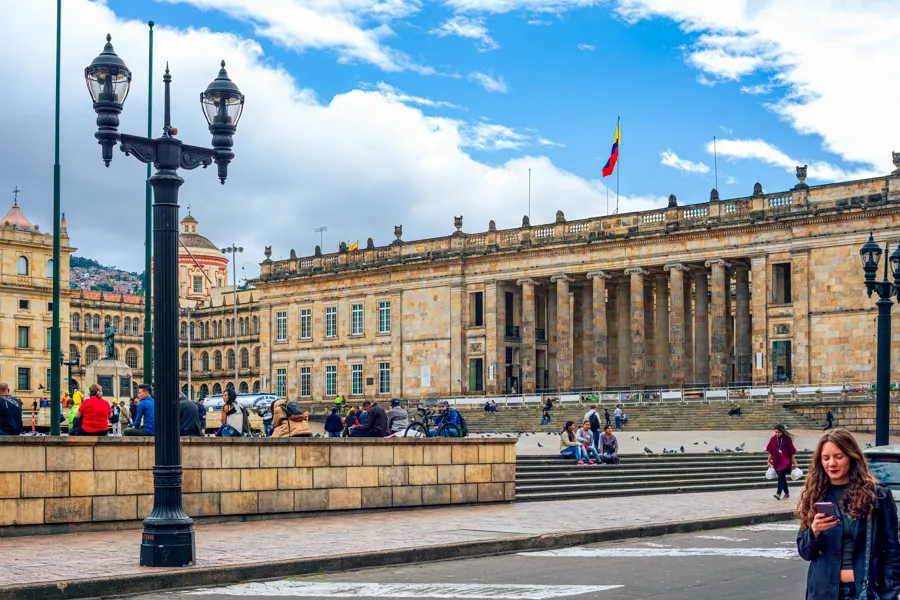 La Candelaria – Plaza Bolivar
Dawn breaks over La Candelaria much as it did centuries ago – first touching the bell towers of the Primatial Cathedral, then creeping down to illuminate streets where colonial-era breakfast spots serve Chocolate Completo just as they did in the 1700s. By dusk, the gas lamps (now electric but maintaining their historic charm) cast the same mysterious shadows that once concealed revolutionary meetings.
Walking allows you to experience how the neighbourhood transforms throughout the day – from the quiet morning hours when shopkeepers arrange their displays, to the bustling afternoon when students from nearby universities fill the streets.
Practical Considerations for Walking
The Altitude Factor
The thin air at 8,660 feet reminds us that we walk the same challenging terrain that the Spanish conquistadors encountered when they first established this mountain capital. Each step at this altitude demands respect, just as it did from the first European settlers and the Muisca people before them. Every step taken in La Candelaria is a step through centuries of history, culture, and living tradition.
Weather and Walking
The legendary weather of Bogotá – “four seasons in one day” as locals say – hasn’t changed since colonial times. Modern-day walkers face the same sudden afternoon showers that once sent Spanish nobles scurrying for cover under ornate balconies.
Beyond the Tourist Trail
Walking allows you to discover how La Candelaria evolved from a Spanish colonial outpost to the beating heart of Colombian and Andean independence. Each street holds stories – from the Casa del Florero, where a broken vase sparked a revolution, to the humble Chicherías, where independence fighters once gathered.
La Candelaria’s soul resides in its historical continuity – the way colonial architecture frames modern life, how centuries-old churches still mark time with their bells, and how traditional artisans work in the same spaces where their predecessors crafted goods for Spanish settlers. These stories reveal themselves only to those who explore on foot, allowing the district’s rich historical tapestry to unfold with each step.
Every walk through La Candelaria is both a journey through space and time – where the footsteps of the present echo those of the past, and where every corner holds the potential for discovering another chapter in Bogotá’s fascinating history. Every step taken in La Candelaria is a step through centuries of history, culture, and living tradition. This isn’t just a walk through a historic district; it’s a passage through the very pages of Colombian history.
Experience La Candelaria: Self-Guided or With Us
While exploring La Candelaria independently is possible, it requires significant research to piece together the full historical narrative. Even with good preparation, you might miss interesting spots, and time constraints often mean you can’t return to places you’ve overlooked. Why not relax and let us handle the details? Book your Historical Bogotá tour with Coromandel Tours and make the most of your time in Colombia’s historic heart.
Additional Links And Information
- Discover Bogotá - A 4-hour walking tour - Curated by Coromandel Tours
- The Best of Bogota - The Capital City in 3 Days - by Mano Chandra Dhas
- Secure Photography in Bogotá and the Sabana – by Mano Chandra Dhas
- Monserrate and Usaquén – The Andes peak and a popular location in a single City Tour
- Visit the Salt Cathedral – A Day Trip to Zipaquirá
- The town of Villa de Leyva, where time stands still – A day trip
All photographs in this article are by Mano Chandra Dhas.

Written by
Mano Chandra Dhas ›Founder of Coromandel Tours. In travel since 1975, from Singapore Airlines to Emirates and Carlson Wagonlit, he now curates private journeys through Colombia, Peru, India, and Nepal from his home in Bogotá. Many of the photographs on this site are his.