What to Do in Medellín: Coffee Farms, Cable Cars, and the Neighbourhoods In Between
Medellín tends to arrive third on a Colombia itinerary, after Bogotá and after Cartagena, and it is often the city people talk about most once they are home. The reason is not a single monument. Medellín has no Gold Museum and no walled colonial city, and a visitor who arrives looking for the set-piece attractions of the other two will spend a puzzled afternoon in the centre wondering what the fuss is about.
What Medellín has instead is a story about itself, told in the neighbourhoods where it happened, and almost none of it sits in the middle of the city. That makes it an unusual place to plan for. The question is less which sights to tick off than which parts of the valley are worth going out to stand in.
The Valley Explains Almost Everything
Medellín fills the Aburrá Valley at roughly 4,900 feet, a long way below Bogotá’s 8,660, which is why it holds a spring-like climate all year and why light layers do for most days in any month. That single geographic fact shapes the whole visit. The flat valley floor holds the centre, the business districts, and the metro line. The steep valley walls hold the hillside barrios that the road network never properly reached.
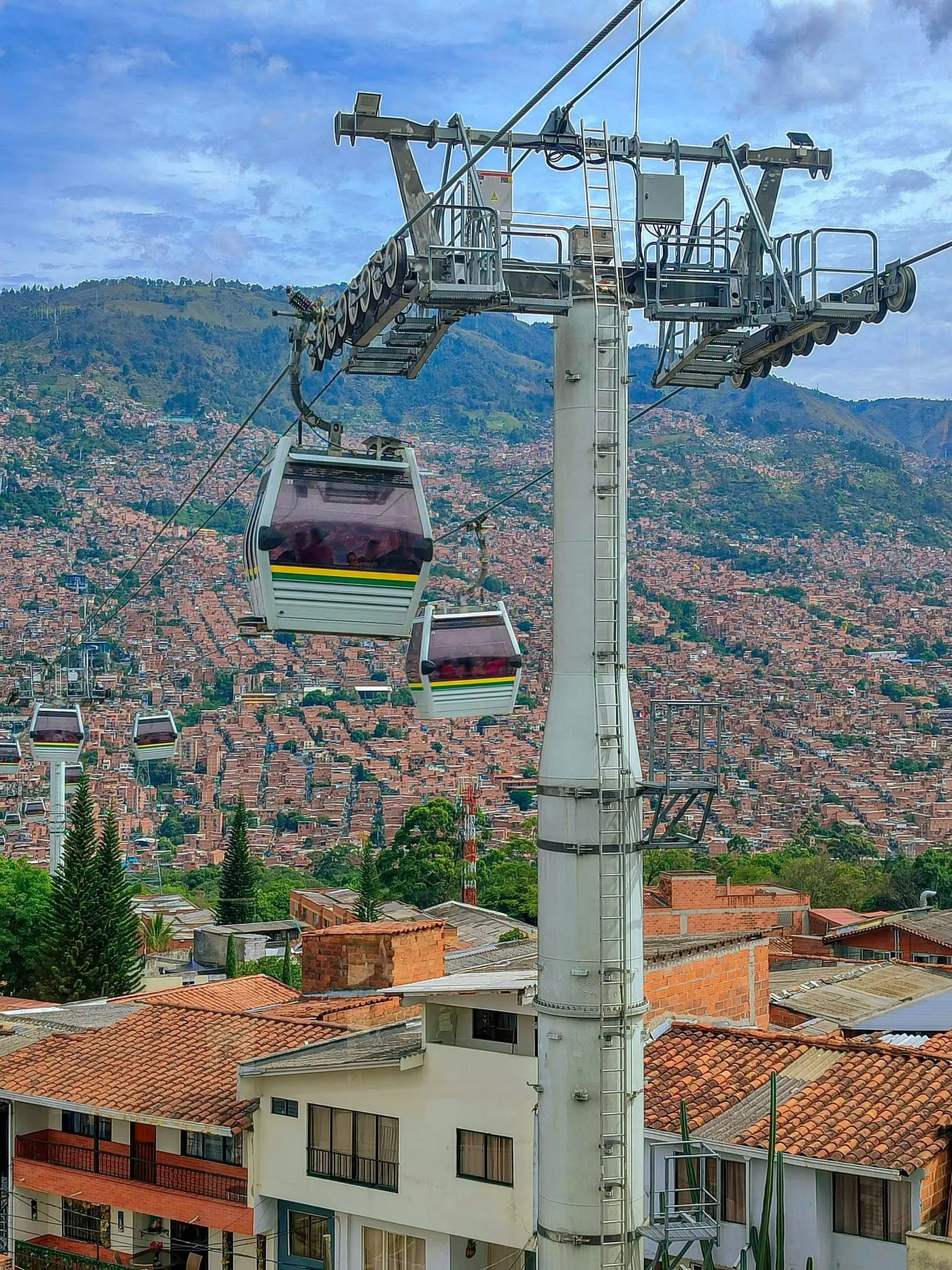
 Metrocable cabins over the rooftops. The system was built as public transport for the hillside neighbourhoods, not as a viewpoint.
The Metrocable was the city’s answer to that problem. It was built as ordinary public transport for those hillside neighbourhoods, and it is now the single simplest way to understand how Medellín is put together, because the view changes as you climb: dense brick housing below, then green ridges, then quiet upland parks. Comuna 13, once one of the most difficult neighbourhoods in the city, is now reached by outdoor escalators and carries some of the best street art in South America.
Begin With the City’s Own Account of Itself
The obvious first half-day is the city tour that goes by the deliberately titled “We Don’t Talk About Pablo”, which takes about four hours and is the best single introduction Medellín has. The name is the point. The tour declines to make entertainment out of the cartel years and instead sets out what the city did afterwards.
It opens at the Museo Casa de la Memoria, a museum documenting the effect of the armed conflict on Medellín’s communities, which is the context everything else depends on. From there it takes the Metrocable over the comunas, then comes back down to El Centro and the Botero Plaza, where twenty-three bronze sculptures donated by the city’s most famous artist stand in the open with the Museo de Antioquia alongside. Four hours is enough to leave you oriented, both geographically and historically, which is exactly what you want from a first morning.
The Neighbourhoods Are the Point
Once the shape of the city makes sense, the good days are the ones spent out in specific neighbourhoods rather than in the centre.
Manrique is a working barrio well off the tourist circuit, and the visit to the Unión Latina dance academy there runs only two hours but is the kind of thing people remember longest. Students perform salsa or tango, properly rather than for show, then you join a class built around the academy’s own teaching method, and the visit finishes over a snack with the people running the project. It is a community initiative using dance as a tool for social cohesion in the barrio, and the two hours are as much about meeting that project as about learning the steps.
 The dance academy in Manrique, a neighbourhood most visitors never reach.
El Poblado, at the other end of the social scale, is where the city’s fashion industry sits, and Colombia’s textile capital has a longer industrial history than most visitors realise. A four-hour walk through the district with a working local designer starts over coffee, takes in landmarks such as the Coltejer building that mark the industrial story, and moves through the boutiques that make up the city’s slow fashion movement. What makes it worth the half-day is the candour: the guide works in the industry and talks about its trends and its problems as an insider rather than a tour operator.
Both of these are half-days, and they sit naturally on either side of a lunch.
Coffee Deserves the Whole Day
Medellín is the natural gateway to Colombia’s coffee country, and this is the one experience that should not be compressed. The farm visit runs a full seven to eight hours, of which around an hour and a half each way is the drive up into the growing hills, and the length is the reason it works.
 Coffee cherries at a family-run farm in the hills above the city. The seed-to-cup sequence takes most of a day to see properly.
At a family-run farm you follow the whole sequence, planting, hand-picking, pulping, fermenting, drying, roasting, and finally brewing, and you take part rather than watch. Lunch is cooked by the farm family and taken with coffee that was on the branch that morning. Anyone who has only ever bought Colombian coffee in a bag will find that the day quietly changes what they think they are buying.
For travellers with more time, the wider Coffee Triangle around Salento and Manizales, with its wax palms and steep green ridges, rewards two or three nights of its own rather than a day trip. That is a different trip, though, and a good reason to talk before booking flights.
The Day You Leave the Valley
The classic excursion out of Medellín is El Peñol and Guatapé, a full day of nine or ten hours taking in the granite monolith with its 740 steps, the reservoir scattered with islands below, and the town of Guatapé, whose buildings carry painted bas-relief panels called zócalos along their lower walls. It is the most photographed day out in the department and it earns the early start. It also needs a full day rather than a half, which is worth knowing before it gets squeezed into an afternoon.
How Long, and When
Three nights covers the centre, the cable cars, and one neighbourhood day. Four is the number we would suggest if coffee country or Guatapé is on the list, because either one consumes a day entirely, and a city this dependent on its neighbourhoods punishes a rushed visit more than most.
The climate makes timing easy, since there is no bad month, though August brings the Feria de las Flores and its flower displays and parades, which is the most distinctive time to be in the city and also the hardest time to find a room. Book early or avoid it deliberately. The one meal to plan around is the bandeja paisa, the regional platter of beans, rice, beef, chicharrón, plantain, avocado, and egg that arrives at lunch and is almost never finished.
Full practicalities are on the Medellín city page. If you are working out where Colombia goes after the capital, or which tours suit a first visit, those are the natural next reads. And if you would rather just tell us what you have in mind, we will tell you honestly how many days Medellín is worth in the trip you are actually planning.

Written by
Mano Chandra Dhas ›Founder of Coromandel Tours. In travel since 1975, from Singapore Airlines to Emirates and Carlson Wagonlit, he now curates private journeys through Colombia, Peru, India, and Nepal from his home in Bogotá. Many of the photographs on this site are his.