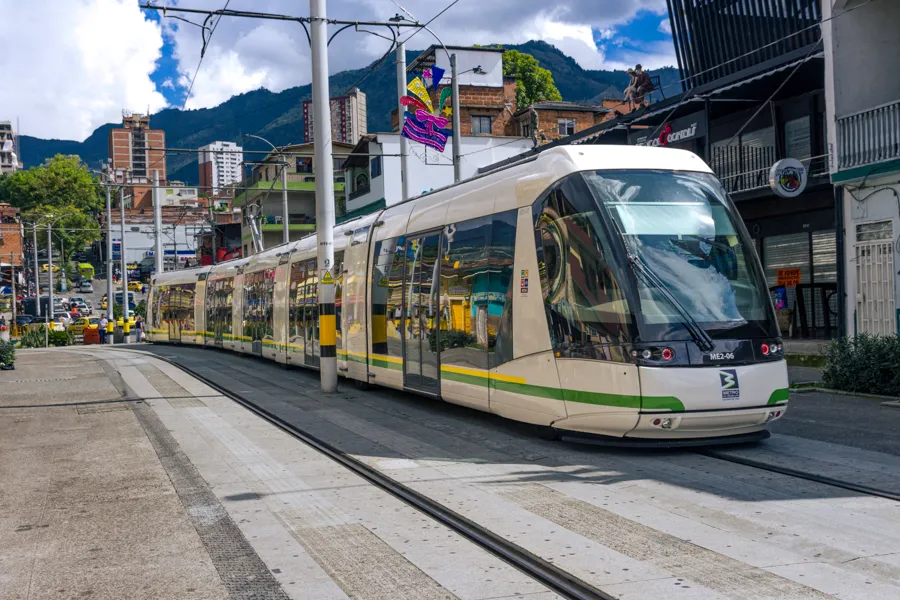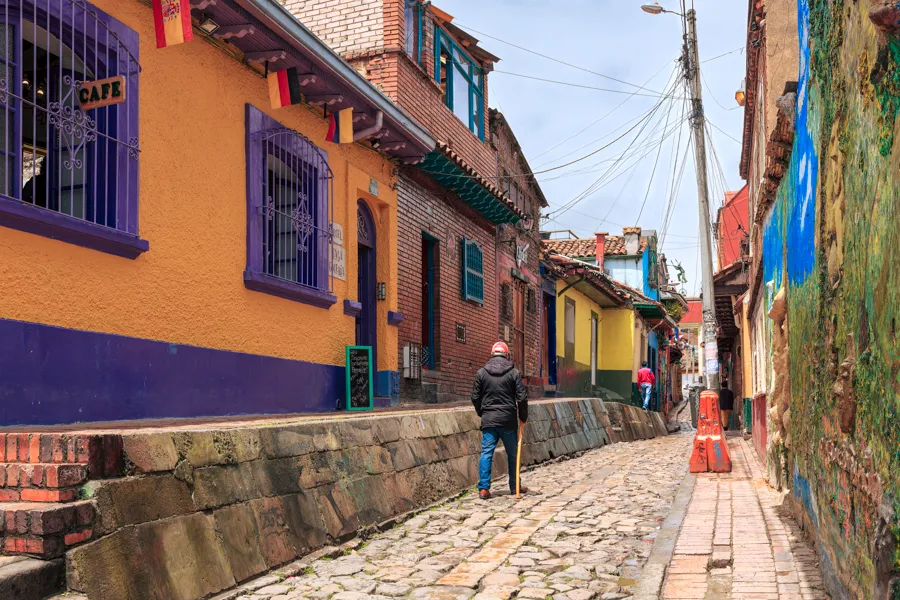
If you are on a short business trip to Bogotá, I would recommend a break after you are done with Business. Go to Zipaquirá, one of the best day trips from Bogotá. Take three or four days off your hectic schedules to relax and enjoy the sights and sounds of the Andes. Leave the capital city behind. I would propose a laid-back trip to the nearby town of Zipaquirá. Here below are my recommendations for the town of Zipaquirá, and a day trip you will not forget.
You may find the names of several towns in Colombia very different from what you’d have encountered in other parts of the world. That is actually one good thing the Spanish colonialists did: they retained the original indigenous names of various towns and cities in the Country. You, therefore, have interesting names like Guatavita, Sesquilé, Tocancipá, Gachancipá and Zipaquirá. The towns and cities are as interesting as the sound of their names.
Arranging Your Transportation For The Zipaquirá Day Trip
As with anywhere else, there are several ways for a traveller to handle the excursion to Zipaquirá. There are three principal ways to get to Zipaquirá:
- Take the Tren Turístico to the Sabana.
- Hire a driver and car for the day.
- Use one of the organised trips to the city.
One way to do it is by train! Yes, you heard right: train. In a city that has no real rail transportation, how would one accomplish that, you may ask?
The Old Colonial Railway
There actually exists in Bogotá the remnants of the old Spanish colonial railway system. Today it serves tourists to the City. The old railway company the Bogotá Savannah Railway was liquidated in 1991. It had provided transportation to the public for over 100 years, from 1889 to 1991. Then, a small group of four friends got together and created the company, Turistren Ltda. The service named the Tren Turístico de la Sabana commenced operations in 1993.
Tren Turístico de la Sabana
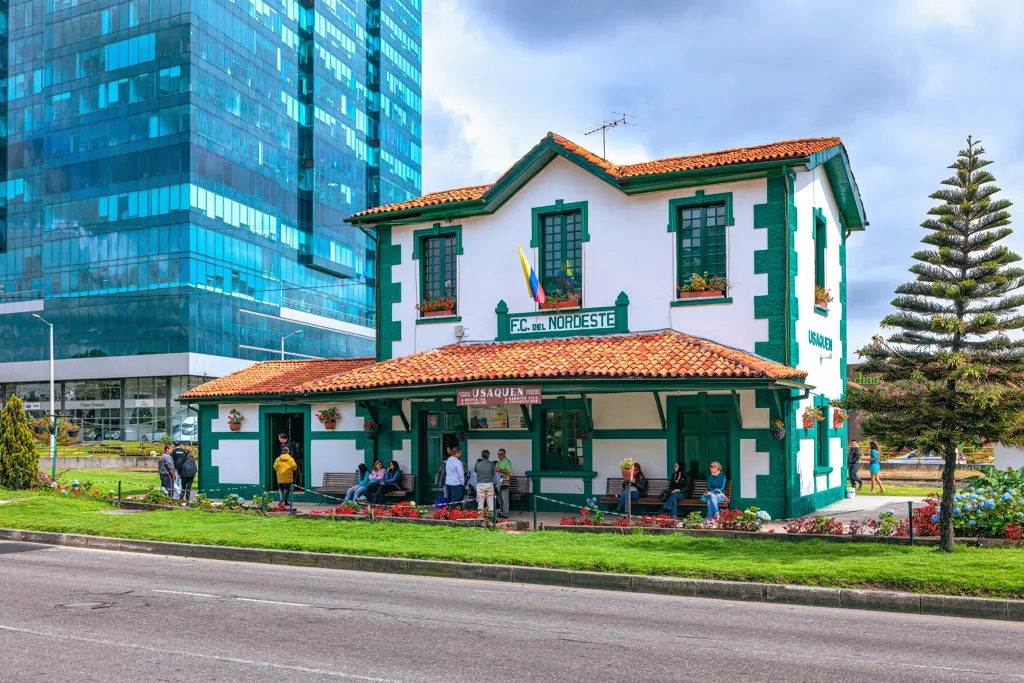 Street-side View of Usaquén Train Station in Bogotá
The train mainly operates during the weekends for tourists. It is pulled by a Diesel engine on Saturdays and by an old steam locomotive on Sundays. Tickets can be purchased in advance from one of the two Bogotá stations. I would recommend that you take the train from the quaint Usaquén Station.
The journey from Usaquén to Zipaquirá takes about an hour and 30 minutes. The old restored carriages, on the old but decently maintained colonial tracks, sort of rock you on your journey through the Sabana de Bogotá. The train hardly reaches a speed of about 30 MPH. There usually is some Mariachi type of entertainment on board.
Once you reach Zipaquirá, there is shuttle transportation in the form of a little mock train, to the Catedral de Sal. A tractor pulls the ‘train’ that has open sides. You will then have to purchase tickets to enter the subterranean halite mines. After your trip to the underground church, the same shuttle will take you back to Zipaquirá station where you will have some time to have lunch and explore the area around the station.
Tickets for the round trip are currently COP 96,000 per adult, and COP 90,000 for children aged 3 to 12 and visitors over 60 (about US $24). You will find details here.
Handling the visit to Zipaquirá on the Tren Turístico has one major handicap: your whole trip has to conform to the train timings. You may not have adequate time to explore the Plaza Mayor and nearby Plaza Independencia.
Driver and Car-hire For The Day Trip To Zipaquirá
Unless you are a Ferroequinologist or a Railway enthusiast, you may wish to take the car-hire route. That is the mode I would recommend. The full-day trip (about 10 hours) will cost about US$250 for two people. The advantage will be that you have a car completely at your disposal and the driver will take you wherever you want to go. You will be at liberty to see the city as you wish. Consequently, you will also be able to cover more of Zipaquirá and explore the town at your leisure. Besides the route may be a little more interesting. You could stop the driver anywhere you please to take a few photos of the Sabana de Bogotá.
The drive will take about an hour and 15 minutes on the Autopista Norte, depending on traffic. If you want the driver to drive you through the towns of Chía and Cajicá, the journey will take about an hour and a half.
It is normally a pleasant drive that will show you the unusual flatness of the high plateau - the Altiplano Cundiboyacense. You will see the cityscape gradually gives way to the picturesque Colombian countryside. Rolling hills, verdant farmlands, and roadside stalls laden with local produce and handicrafts stretch out before you. The distance to Zipaquirá is approximately 31 miles, but you will find that time flies away as you gaze at the lovely Andes scenery.
I will not go into any of the organised tours. I personally find them restrictive and the cost will be more or less the same as by a private car with a driver. There will not be any great savings.
Zipaquirá the City
Founded in the year 1600 CE and classified as a city in Colombia, Zipaquirá has a population of 169,869 people (2026 DANE projection). In Chibcha, (the language of the Muisca people), the name of the city in one of the explanations, means the land of the Zipa. The Zipa was the ruler of the territory.
In El Abra Valley, the area between Zipaquirá and Tocancipá was found some of the first evidence of human settlement in the Americas. Carbon dating proved the bones and carbon fragments found, to be about 12,500 years old.
The Halite Mines
Zipaquirá’s halite mines have captivated the imagination for centuries. As far back as 2,000 years ago, local tribes held the secret location of these precious mines to themselves. They played a vital role in their economy.
During the Spanish colonial era, salt was as valuable as gold. Soldiers were often paid in this prized mineral. Intrigued by the tales of these legendary mines, the Spanish relentlessly pursued their discovery, ultimately unveiling the mines’ well-guarded location. The mines are where the Catedral de Sal is located.
The Salt Cathedral of Zipaquirá - A Subterranean Icon of Colombia
Located deep in the heart of the Andean mountain range, the Salt Cathedral of Zipaquirá stands as a testament to human ingenuity and spiritual devotion. This subterranean creation, situated within an ancient halite mine offers visitors a unique and memorable experience.
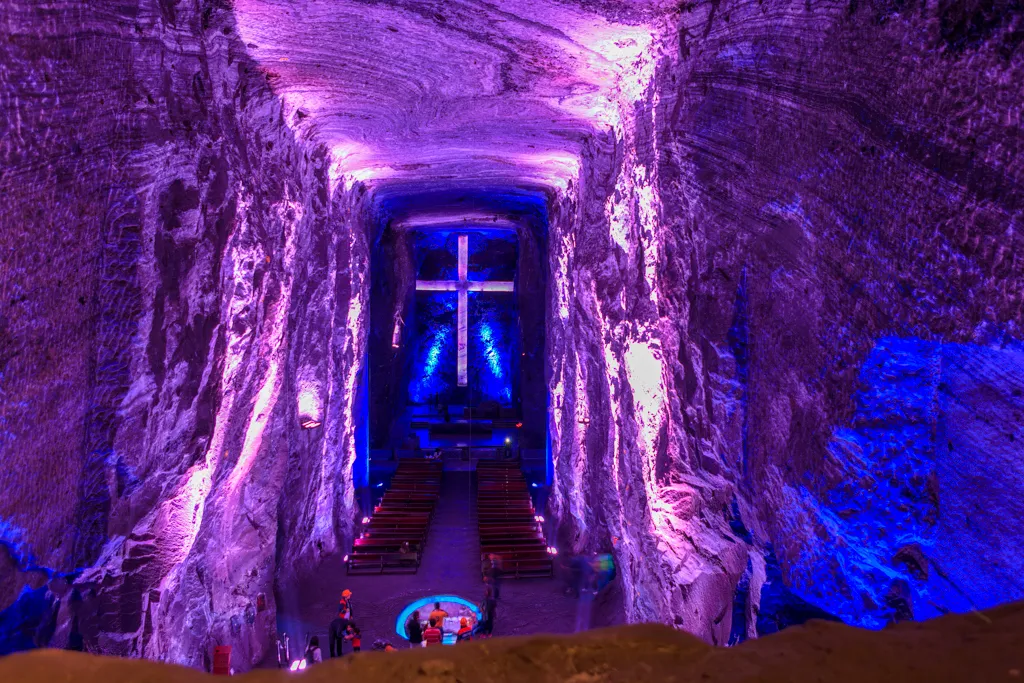
The Catedral de Sal in Zipaquirá
The Salt Cathedral’s origins date back to the early 1930s when miners began carving a small sanctuary for daily prayers within the mine. Over time, this humble space evolved into an underground church. In 1995, the current version of the Salt Cathedral was inaugurated. Contrary to its name, the location is a living church. It is not a cathedral in Roman Catholic terms. Today, it is regarded as one of Colombia’s most iconic religious and architectural landmarks, attracting thousands of tourists and pilgrims annually.
Descent into the Catedral de Sal
As visitors descend 590 feet below the Earth’s surface, they follow a winding path lined with the Stations of the Cross, each meticulously carved into the halite walls or entrances to mine shafts. The journey leads to the barrel vault, the heart of the Salt Cathedral, where an impressive 52-foot-tall cross, the world’s tallest indoor cross, stands proudly behind the main altar. The cross originally an icon of torture and death, is now the main symbol of the Religion. Colourful LED Lights decorate the unusual architecture of the church. They illuminate the cavernous space, creating an otherworldly ambience of peace and quiet.
Beyond its religious significance, the Salt Cathedral of Zipaquirá is also a symbol of Colombian cultural heritage. The mine itself boasts a rich history, with indigenous Muisca people extracting salt from the site for thousands of years before the arrival of Spanish colonisers. It offers travellers a unique opportunity to explore the intersection of faith, art, and history deep within the enchanting Andean landscape. This extraordinary subterranean location is a must-see destination for anyone visiting Colombia. It promises an experience that is guaranteed to leave a lasting impression.
Photography at the Catedral de Sal
For photography enthusiasts who mainly shoot with a mobile camera, you may use your mobile phone, to record some if not all your subterranean memories. Please note that flashes or strobes will not work for the background, because it will be too far away for your flash to capture.
For those who are more serious about their photography, you may need to carry a light tripod down with you. If you wish to bring a person into the photo, use a timed exposure (to capture the background), and the second curtain setting on the DSLR to activate the flash for the person in the frame. Alternatively, you could use high ISO speeds but may be left with some noise in your photos. The choice is yours. Personally, I have carried a heavy tripod down into the mine.
Plaza del Minero
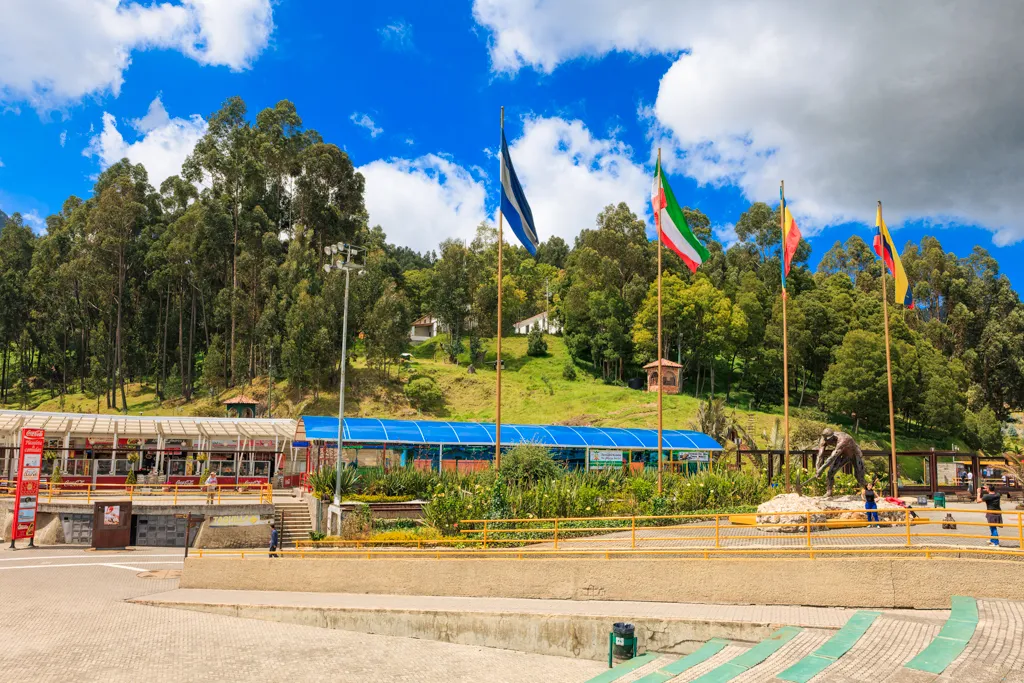 The Plaza del Minero, Zipaquirá
Climbing back to the surface may take a little more effort than your descent. Once back to the sunlight (or lack thereof if the sky is overcast), of the Plaza del Minero, explore the small plaza. You can climb up to the edge of the small amphitheatre. From there you can see the newer part of Zipaquirá city.
Maybe, it is now time for a snack. Try a Palito de Queso (a longish cheese bread), with a cup of coffee in one of the small restaurants outside the mine. A word of warning here: the coffee in these restaurants may not measure up to the reputation of Colombia’s legendary coffee! For lunch you could head towards the Parque Principal, the old main town square of Zipaquirá, just a 5-minute drive away; or maybe, you should save that for the Plaza Independencia.
The Old Town of Zipaquirá
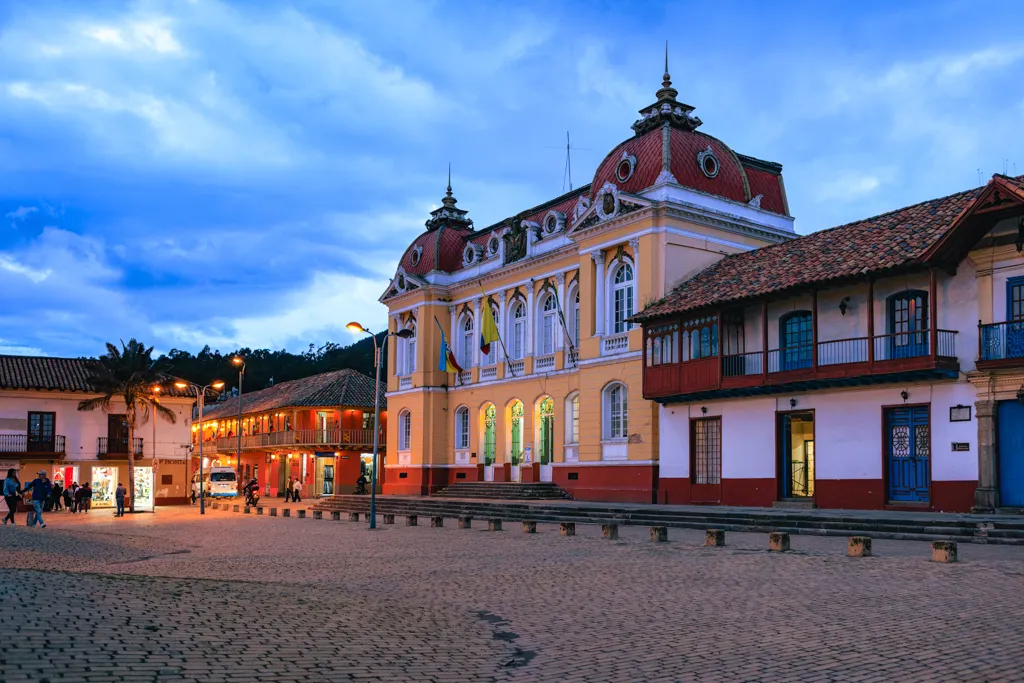 Zipaquirá, Colombia - The Town Hall in the Main Town Square
The most interesting places in the old town of Zipaquirá are its two main squares. The larger one, the Parque Principal, is typical of old colonial Spanish squares. It features a church (in this case, the cathedral), banks, the mayor’s office, restaurants, shops, and usually, a police station. In Zipaquirá, you will also find on the square, the Town Hall with its unique architecture.
If you wish, visit the cathedral for a quiet moment or snap a few photographs, take care not to disturb people praying, or any mass that is in progress.
Plaza de la Independencia
 Zipaquirá, Colombia - Flags and Local People on Plaza Independencia
After you have had your fill of the Parque Principal, take a walk to Plaza Independencia which is another interesting square just one block away. Facing the Cathedral, turn left onto the road just in front of the Cathedral (click here for the map), walk across one block and you should be on the Plaza de la Independencia. It was created to celebrate Simón Bolívar’s liberation of the six Andean countries from the colonial power of Spain. You will find the flags of the countries he liberated, flying on the Square. There are more cafes and restaurants on Independence Square than on the main square.
Time for Lunch
It is finally time for a well-earned lunch. Walk around the square to locate a restaurant of your choice. There will be staff outside most eating places trying to entice you into their restaurant for your meal if it is still lunchtime. You could even try an Ajiaco if it is available. It is a sort of soup dish with lots of items inside it to eat including corn, beef etc. It may not be a recommended dish for Muslims, who could try grilled Trucha (trout) with lemon and garlic, instead. Even if it is past lunchtime they will usually take your order and cook you the meal of your choice, or make you a sandwich.
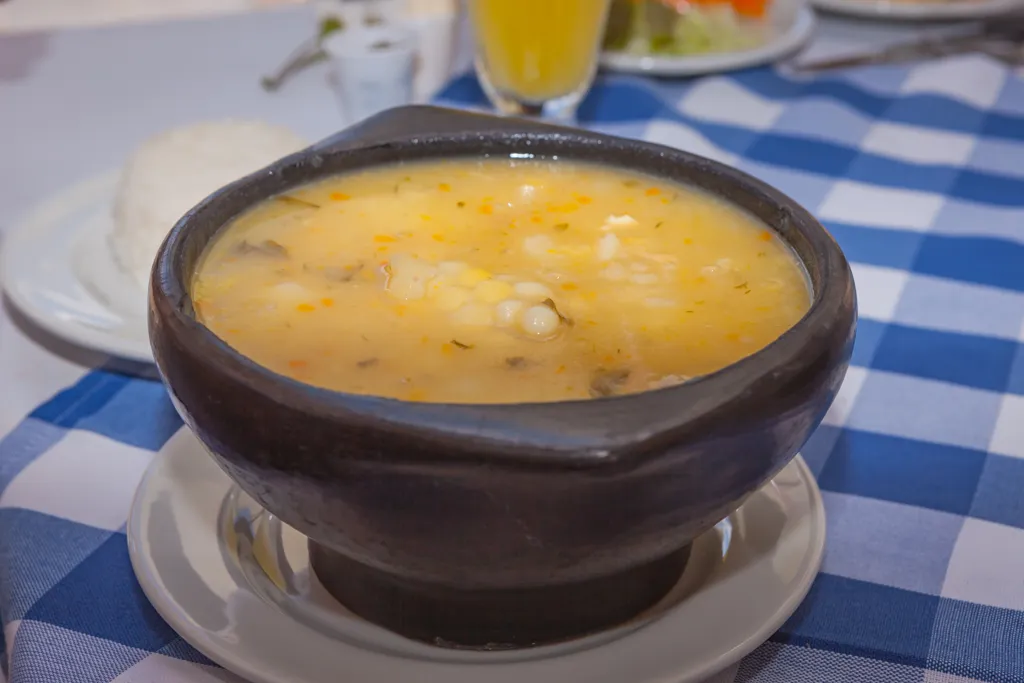 Ajiaco - Considered a Colombian Speciality
Colombians are generally meat eaters. Vegetarians can sometimes have a few challenges. If you are one of those who do not eat eggs as well, please make that clear to the restaurant staff. These days however with several Colombians being vegetarians, some restaurants will have a vegetarian menu.
Having finished your lunch, you may wish to walk around the square for some final photos of Zipaquirá and the square, especially the flags. After that, it is time for your return back to Bogotá.
Back to Base And A Lasting Impression On The Day Trip To Zipaquirá
As you return to Bogotá, you will take back with you, some very pleasant memories. You will ponder the day’s exceptional experiences. The Salt Cathedral, the streets and squares of Zipaquirá. You may also take with you a feel for the lingering presence of Muisca traditions and the long-lasting influence of the Spanish Conquistadores. They will forever be etched on your memory.
This itinerary was designed as a DIY itinerary. If you would like the tour organised with transportation and a guide, here is some information.
In Conclusion:
A day trip from Bogotá to Zipaquirá offers a unique adventure, revealing the hidden gems of Colombia’s countryside and the awe-inspiring Catedral de Sal. This unforgettable experience will certainly leave you longing to uncover more of Colombia’s fascinating history and natural beauty.
Additional links and Information
- A visiting photographer in the Sabana de Bogotá; safety and Security - by Mano Chandra Dhas
- Read about my recommendation for the Andes capital city of Bogota here.
- What is the Sabana de Bogotá? Click to read.
- Read about the El Abra Valley where was found some of the first evidence of human settlement in the Americas.
All photographs in this article are by Mano Chandra Dhas.

Written by
Mano Chandra Dhas ›Founder of Coromandel Tours. In travel since 1975, from Singapore Airlines to Emirates and Carlson Wagonlit, he now curates private journeys through Colombia, Peru, India, and Nepal from his home in Bogotá. Many of the photographs on this site are his.