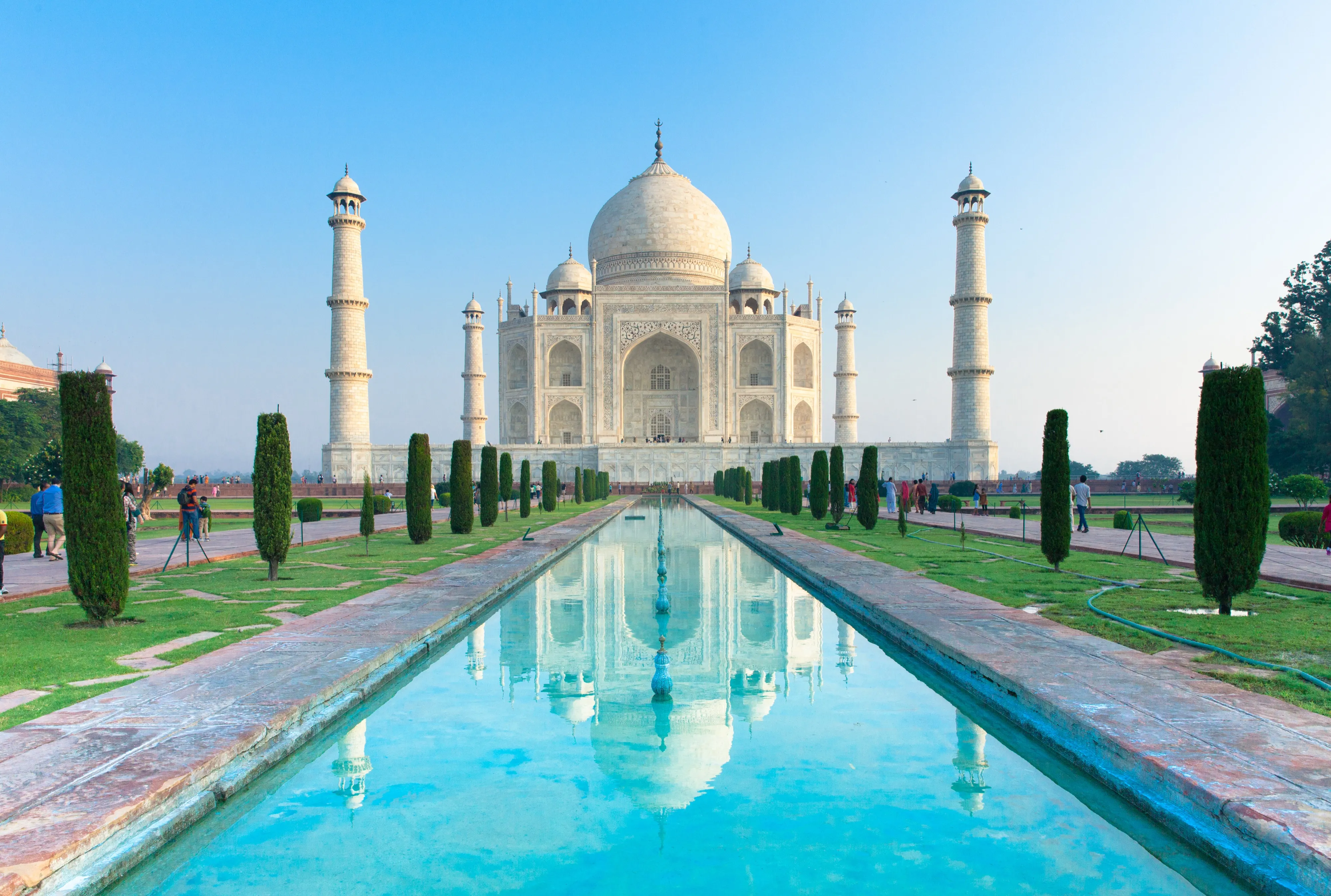
The Golden Triangle, Four Ways: How to Choose the Right Delhi, Agra, and Jaipur Itinerary
The Golden Triangle is the most travelled route in India, and it earns the traffic. Delhi, Agra, and Jaipur sit within a day’s drive of one another, and between them they hold an extraordinary share of North India’s history: the mosques and tombs of the Mughal capital, the Taj Mahal, and the pink sandstone city of the Rajput kings. For a first visit to India, it remains the sensible place to start.
What the name hides is that the Golden Triangle is not one trip. It is a family of trips built on the same three cities, and the decision that actually shapes your journey is not whether to go but what, if anything, to add. We offer the route in four versions, from a focused seven days to a ten-day arc that ends on the banks of the Ganges. They suit different travellers, and the differences are worth spelling out plainly.
The Classic Route: Seven Days, Three Cities
The classic Golden Triangle tour is the distilled version: seven days, beginning and ending in Delhi, with your own guide and vehicle throughout.
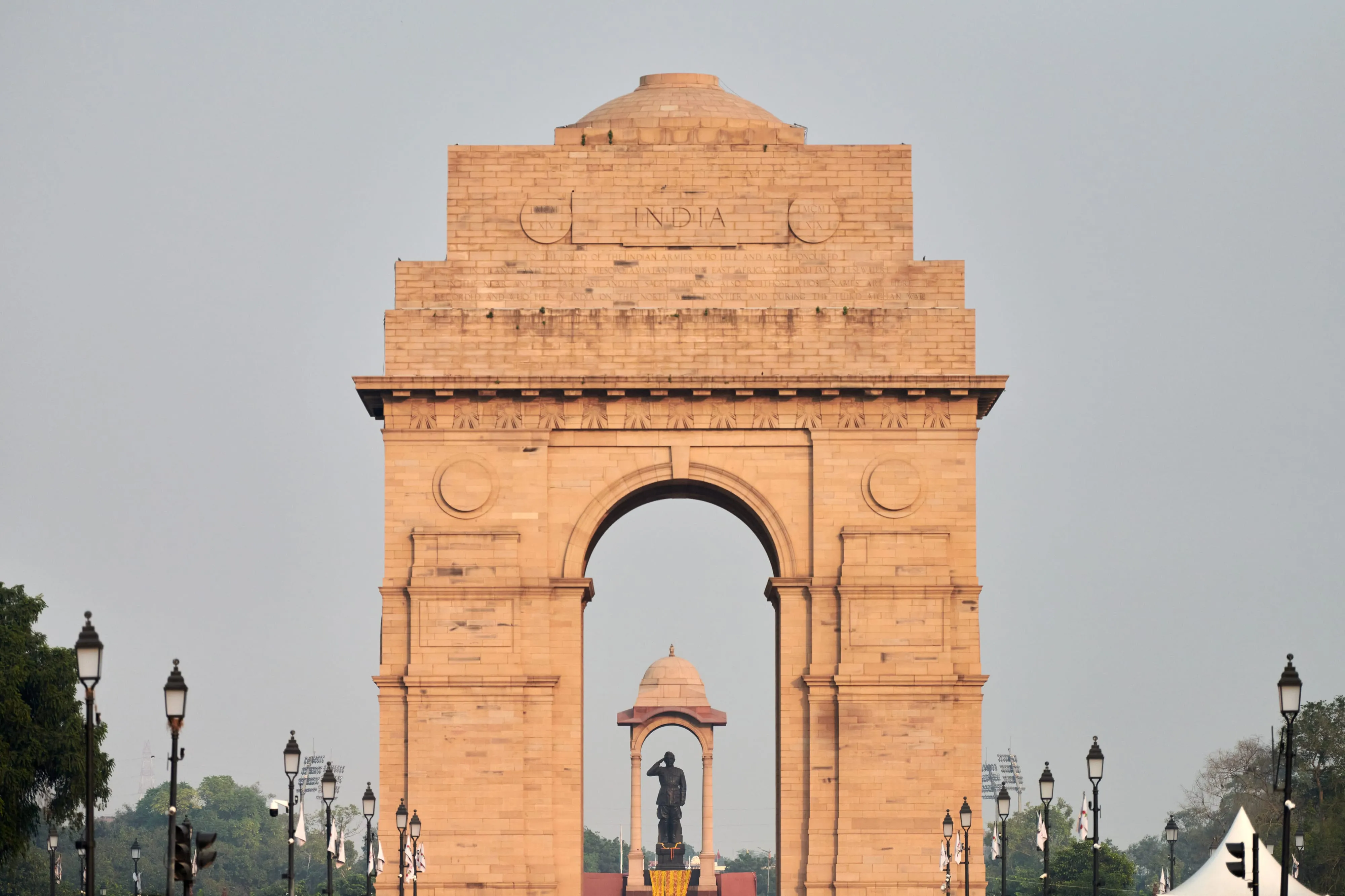 India Gate, at the heart of Edwin Lutyens’ New Delhi, one of the landmarks of the capital’s city tour.
It opens with a day across Old and New Delhi, from the 17th-century Jama Masjid and a cycle rickshaw ride through Chandni Chowk to Humayun’s Tomb and the Qutab Minar, the tallest brick minaret in the world. Agra follows, with Agra Fort, the Taj Mahal, and the quieter Itmad Ud-Daula, known locally as the Baby Taj. The drive to Jaipur passes through Fatehpur Sikri, the red sandstone city that served as the Emperor Akbar’s capital for just fourteen years. A full day in Jaipur takes in the 16th-century Amber Fort, the Hawa Mahal, the City Palace, and Jantar Mantar, the 18th-century royal observatory.
This is the right choice if your time in India is limited, if this is a first visit, or if the monuments themselves are the point. Nothing essential is missing, and the pace leaves room to breathe. Hotels come in a choice of five-star luxury or four-star heritage categories, including one of Delhi’s original hotels, established in 1903.
With Ranthambore: Add the Tigers
The Golden Triangle with Ranthambore stretches the route to nine days and threads a wildlife reserve into the middle of it. After Delhi and a sunrise visit to the Taj Mahal, the road turns south to Ranthambore National Park, a dramatic landscape of rocky hills, grassy meadows, lakes, and ruined forts.
 A Bengal tiger in Ranthambore National Park, one of India’s finest reserves for seeing the animal in the wild.
A full day of morning and afternoon game drives gives the best odds of seeing a Bengal tiger in the wild, along with leopards, hyenas, crocodiles, and a rich birdlife. From the park it is a comparatively short drive on to Jaipur, so the detour costs less road time than the map suggests. This version also swaps the standard Delhi programme for something slightly more intimate: a visit to Gurudwara Bangla Sahib, the Sikh temple, includes time in its community kitchen and a turn at making chapatis.
Choose this one if a trip built entirely of monuments feels one-note to you, or if a tiger sighting has been on the list for years. No sighting can be guaranteed, which is the honest truth of any wildlife travel, but two game drives in Ranthambore is a serious attempt rather than a token one.
With Udaipur: Add the City of Lakes
The Golden Triangle with Udaipur also runs nine days, but instead of wildlife it deepens the Rajasthan chapter. After Jaipur, the road continues south through the Aravalli Hills to Udaipur, considered one of the most romantic cities in India.
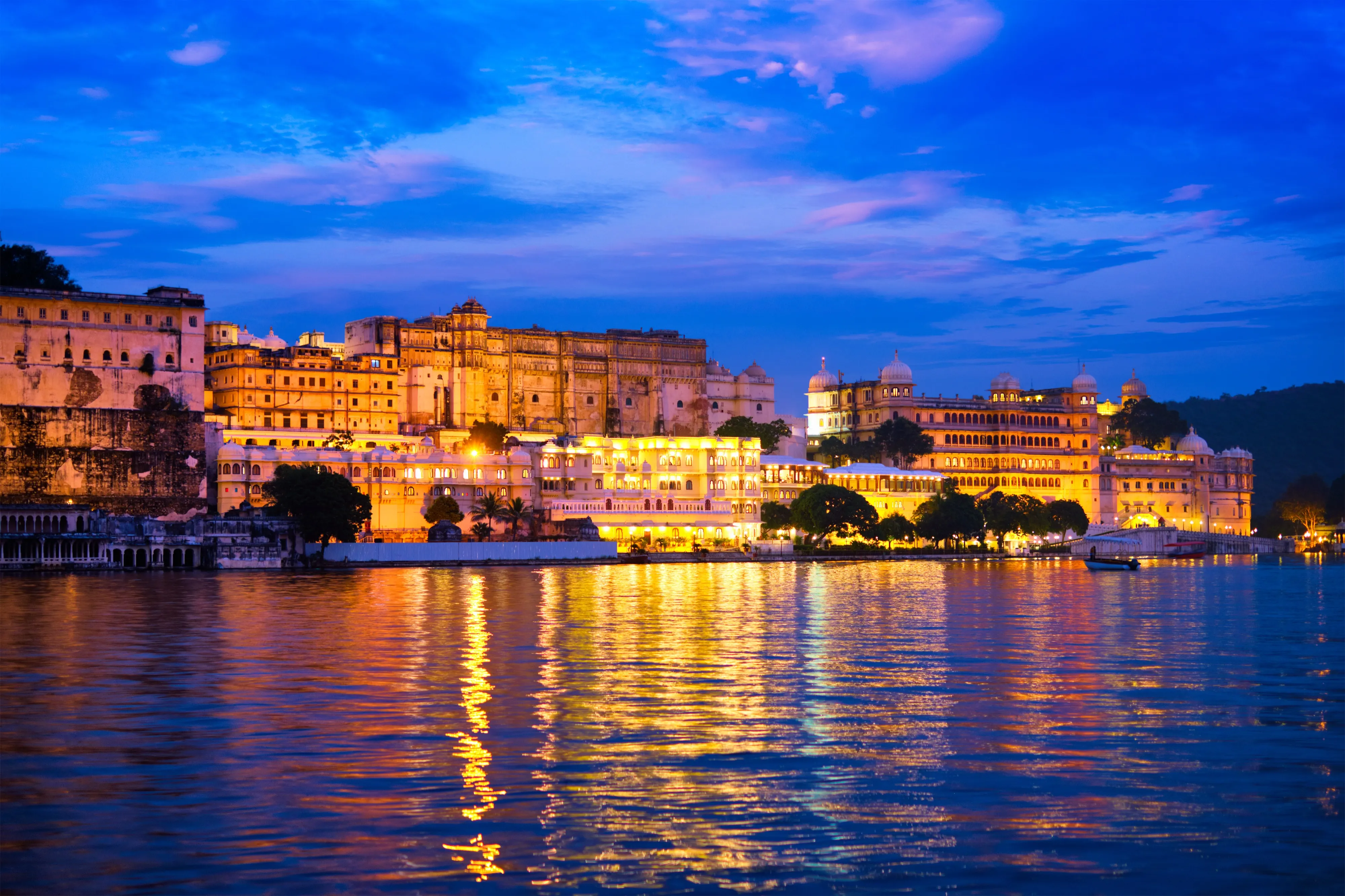 Udaipur’s City Palace above Lake Pichola. The boat ride across the lake is among the most iconic experiences in Rajasthan.
The Udaipur day moves from Jagdish Temple through the courtyards of the City Palace to the fountain garden of Saheliyon-ki-Bari, and ends with a boat ride on Lake Pichola, past the island palaces of Jag Mandir and the Lake Palace. The return to Delhi is by air, which keeps the long-distance driving within reason.
This is the version for travellers drawn to Rajasthan itself: the palaces, the lake country, and the unhurried evenings. It is a natural fit for a wedding anniversary or any trip where the mood matters as much as the itinerary.
With Khajuraho and Varanasi: Add the Sacred
The Golden Triangle with Khajuraho and Varanasi is the fullest version, ten days that carry you beyond Rajasthan into India’s spiritual heartland. After Delhi, Jaipur, and Agra, a morning train and a drive through the fort complex at Orchha bring you to Khajuraho, whose UNESCO World Heritage temples, including the Kandariya Mahadeva, are among the most remarkable sacred buildings in Asia. A flight then connects to Varanasi on the Ganges.
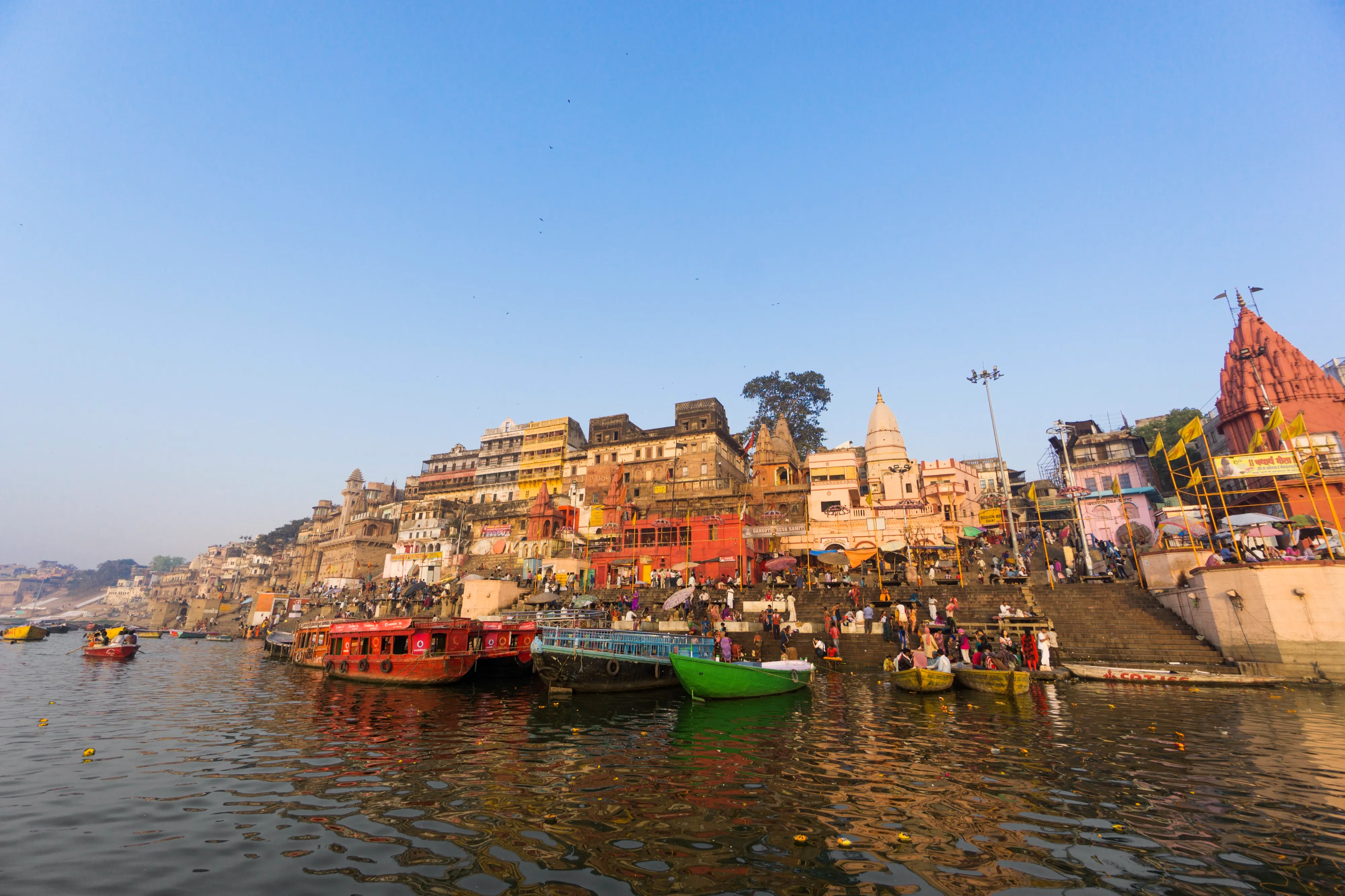 The ghats of Varanasi at dawn. The sunrise boat ride on the Ganges is one of the most stirring experiences in India.
Varanasi delivers two of the most affecting hours anywhere in the country: the evening Aarti ceremony at the ghats, and a boat ride on the river at first light. A short drive away lies Sarnath, where the Buddha preached his first sermon.
This is the version for the culturally serious traveller, and it is also, not coincidentally, the one with the most moving parts: a train, two internal flights, and five hotels. That is precisely the kind of itinerary where having someone else responsible for the connections changes the experience. We have written elsewhere about what a curated tour actually is; this route is a good illustration of why the model exists.
How to Decide
Start with the honest arithmetic of your time. Seven days covers the triangle itself; nine days buys tigers or lakes; ten days reaches the Ganges. Resist the urge to compress a longer version into fewer days. The distances are real, Delhi to Agra alone is around four hours by road, and the trips are paced the way they are for a reason.
Then ask what kind of memory you are travelling for. If it is the great monuments, take the classic route and give them your full attention. If it is wildlife, Ranthambore. If it is atmosphere and romance, Udaipur. If it is the sacred and the ancient, Khajuraho and Varanasi, and accept the extra logistics as the price of the two most powerful days on any of these itineraries.
A few practical notes apply across all four. The season matters: October to March is the time to go, before the heat builds. The calendar matters too, in smaller ways that itineraries have to be designed around: the Taj Mahal closes every Friday and Delhi’s Red Fort every Monday, which is exactly the sort of detail that decides what order a well-planned week runs in. And all four versions are private tours, with your own guide, driver, and air-conditioned vehicle, so the pace is yours to set: a considerable difference if you prefer, as most of our clients do, to see fewer things properly rather than many things briefly.
The full set of itineraries, including routes beyond the Golden Triangle into Kerala, Kashmir, and the east, is on our India tours page. If you are weighing two of these against each other, tell us what you are hoping for and we will give you a straight recommendation.

Written by
Mano Chandra Dhas ›Founder of Coromandel Tours. In travel since 1975, from Singapore Airlines to Emirates and Carlson Wagonlit, he now curates private journeys through Colombia, Peru, India, and Nepal from his home in Bogotá. Many of the photographs on this site are his.