Are you planning a holiday to Colombia, in South America? Do you wish to drive in the Country? If I were you, I’d be wary. Driving in Bogotá can be a challenge to even the most experienced drivers!
On the Road
Colombianos are generally friendly, happy, and easy-going people. Everything, however, changes when they get behind the wheel of a vehicle. Be it a car, bus, or truck. Motorcyclists are notoriously dangerous people on the roads of Bogotá.
When it comes to their driving, many local drivers are aggressive. Their vehicles can become lethal pieces of machinery on the roads. This Jekyll and Hyde syndrome is difficult to understand. Why would a perfectly friendly, understanding person turn into a monster behind a steering wheel? It makes driving in Bogotá a challenge for visitors.
Personally, I would put it down to bad education and learning-to-drive processes. It appears that many learn to drive from a relative or a friend. While they have been taught to move and control a vehicle, they are badly educated in the rules of the road.
Etiquette and Regulations - Driving in Bogotá
While driving, several Colombians do not go by the rule book. They will overtake on the wrong side, switch lanes without indicating, turn left or right from the middle lane cutting across a lane that has traffic going straight — just about everything that you would expect a well-trained driver not to do. I wonder if they think they are being extra smart drivers. They probably do.
Changing Lanes
In most parts of the civilised world, if one is indicating that one is going to change lanes, the person behind you on that lane, will permit you to change lanes. It is part of driving regulations. Let alone driving regulations, it is part of civilised human behaviour.
Here in the capital city of Bogotá, the person in the lane you want to move to will speed up, as will everyone else behind him, or her. It is as if they are telling you, “I have to go first. You can change lanes when someone else lets you do that.” It is the cause of many accidents. Buses will behave that way too. If you are driving in a car and want to change lanes, you will have to be very cautious.
Talking about changing lanes, the average Colombian does not seem to know the real reason why indicator lights exist in a vehicle. They only use it when they want to break a rule.
Weaving Through Traffic
Another irritating local habit often displayed is weaving or switching lanes. If there is a Trancón (a Colombian term for a traffic jam), the situation gets worse. Many drivers will switch lanes just because they think the other lane is moving faster. They simply have to be in the lane that they perceive to be moving fastest. Quite often at the traffic lights that have changed to red, I see the same people who were crazy weavers, now by my side! They would have gained nothing by their weaving processes.
Park Anywhere
 Stopping at a green light to pick up a passenger
I have often seen people park their vehicles in blatant violation of traffic laws, here in Bogotá. It could be in No Parking Zones; it could even be right at the traffic lights. Cars and even trucks are sometimes parked just a few yards before a traffic light that has turned green, before road intersections or in the slow lane. They callously block all the traffic behind them. If drivers did that in many other parts of the world, they would most definitely get a Traffic Ticket within minutes. Here in Colombia, policemen would ride by without batting an eyelid.
One-Way Lanes - a Note for Driving in Bogotá
In Colombia, one-way lanes are not normally indicated by the familiar international, circular ‘No Entry’ sign. Here, one has to be on the careful lookout for Arrow Signs. The Arrows tell drivers the direction in which traffic is legally allowed to move. It is not uncommon to see some local drivers driving on a one-way lane, in the opposite direction to the permitted flow of traffic. I am unable to get my head around that phenomenon. Where there is space for a vehicle to move into, a Colombian driver, will move in. They don’t care what happens to others on the road.
Racing Stoplights
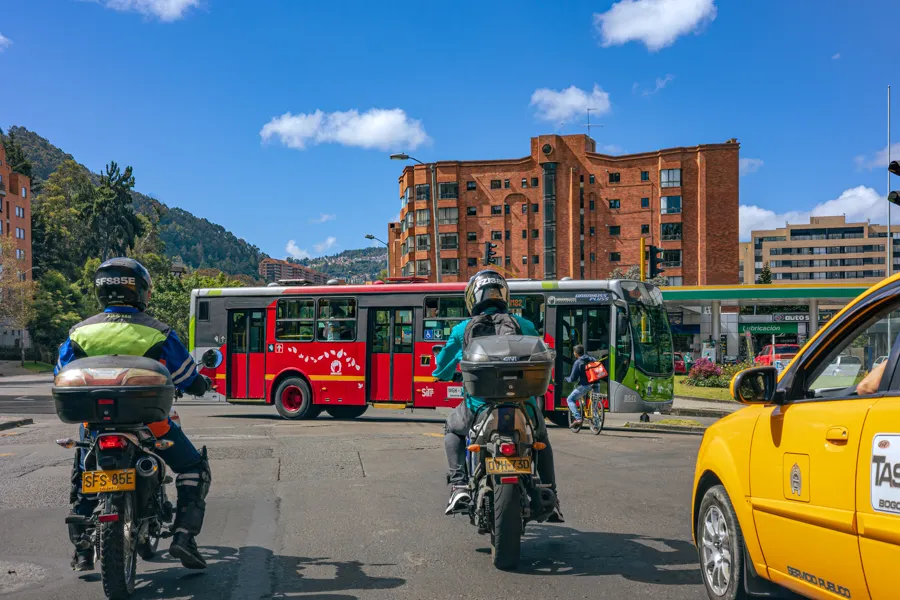 Public transportation goes through a red light when he has to stop.
As a traffic light changes to Red, there will always be a driver who races the lights. Bus drivers do that as well. Many will go through a stoplight. This happens at every traffic light, every day. If you are slowing down to stop at an amber light, there will always be the odd driver who will overtake you and with a devil-may-care attitude, go through a red light. It is indeed a miracle that there are not as many accidents as there could be on the streets of Bogotá.
Mountain Roads
The Altiplano Cundiboyacense is a high plateau on the Andes Mountains with most of the area being rather flat – even at around 8,660 feet above mean sea level. There however are often sections of roads that go through mountainous terrain. Such areas always call for caution and orderly driving. A single bad driver could cause a very serious incident.
Honk Honk
The traffic lights are red. You have stopped. Anyone knows that by studying the pedestrian crossing lights, you can estimate when your light will turn to Green again. Here in Bogotá, two seconds before the lights turn to Green, people behind you will start to honk. “Move over; there is another Colombian in a hurry behind you!” Just ignore the bad-mannered honkers.
Drive Defensively While Driving in Bogotá
The only way to cope with the thoughtless and selfish attitudes of the errant Colombian driver, is to drive defensively: expect every other driver in town to break established traffic rules. Be prepared for anything. If one cannot be that careful on the streets of Colombia, it may be better not to drive in the Country.
To Drive or Not to Drive in Bogotá
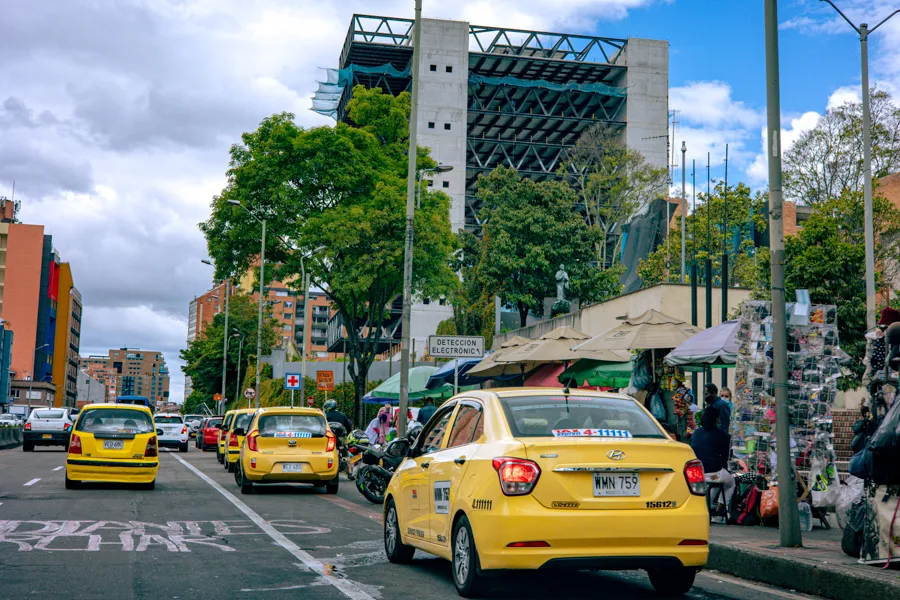
Yellow Taxis in the Chapinero area of Bogotá
If you are on holiday in this lovely capital city, it may be best not to drive. Take a Taxi instead. The Zapaticos (translates to, “little shoes” – what Bogotanos call their little taxis), to and from the popular sites in the City are inexpensive. On the other hand, not driving may limit your experience of exploring the Sabana de Bogotá (the area around the capital city) and seeing some of its quaint little towns. Not driving will be the safer option. By the way, it is best to call for your taxi through a mobile phone app. It is not recommended to hail a taxi on the street.
Driving Licences for Driving in Bogotá
If you must drive in Colombia, you can do so with an International driving licence or the national licences of your own country together with your passport. However, the minute you move to a Residence Visa, you will have to get a local driving licence. Licensing involves driving, written and health tests.
Crime and Deception
Serious crime while driving around the Country is minimal. It is, however, recommended that you use one of the many car parks in every area (usually within a few hundred yards), to park your car. Parking on streets is not recommended.
The Pito Saga
I must mention what I would refer to as the Pito Saga in Colombia, to potential drivers. In some areas, a motorcyclist who appears to be weaving through traffic will ‘expertly’ plan a small device, which is referred to as a ‘Pito’ in Colombia. In English, that would translate to ‘pipe’ or ‘whistle’. It is a small, sharpened metal tube that will pierce the tyre before which it was planted. The driver may hear a whistling sound as air escapes from the pneumatic tyre. It will be flattened within about 300 yards.
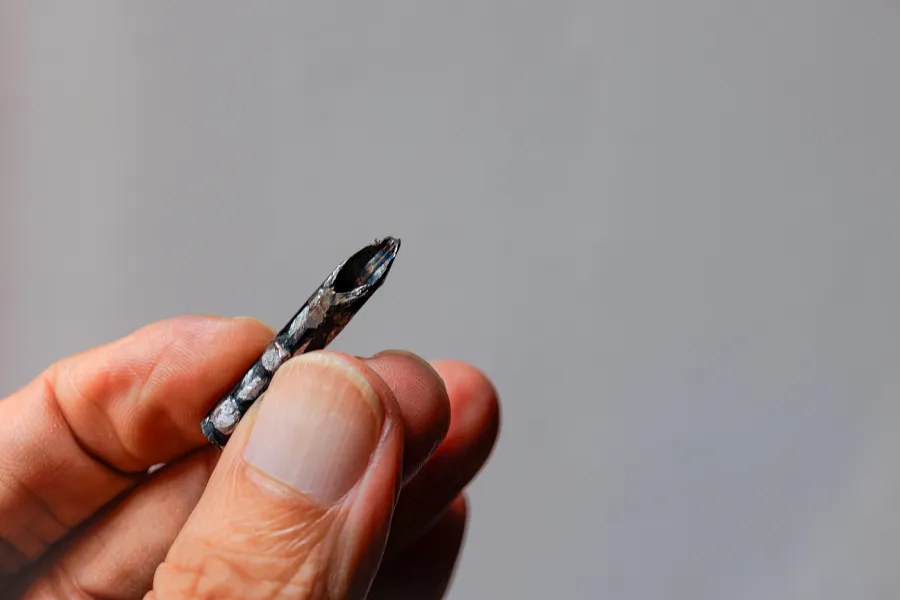 The Infamous Pito
The same criminal who planted the Pito will come around and offer assistance to change the tyre, pretending to be a good Samaritan. He will then recommend a tyre puncture repair shop about 500 yards ahead.
My advice would be not to listen to this person. Not even to lower your window and talk to him. Never get out of the car to examine the flat tyre. Just stay in the car and call the insurance company with which the car is registered. They will send a person to change your tyre.
Please do not under any circumstances follow the advice of the Pito-criminal and visit the tyre repair shop he recommended. If you do, one puncture will magically become 10 punctures. Instead of paying $10 for a single puncture repair, you will end up paying $100 for 10 punctures. The entire Pito experience has happened to me.
Conclusion
Only in India, are there some cities where driving is more difficult, but that is a different story altogether. Here, Colombians believe they are the best drivers in the world. They will proudly tell you, “If you can drive in Bogotá, you can drive anywhere in the world!”
While not a very safe country to drive in, there is much to be seen in this lovely Andean part of South America. Click on this link to read about my recommended itinerary for Bogota or here for my post on a day trip to Zipaquirá. Welcome to Colombia!
Useful Links
- A walking tour of the heart of Bogotá - Coromandel Tours
- Walking through time: exploring Bogotá’s La Candelaria on foot – Blog post by Mano Chandra Dhas
- Click here to read about Bogotá - Colombia’s capital city. Source: Wikipedia
Driving in Bogotá – FAQs
Can a tourist in Colombia, drive in the Country?
Yes, a tourist can drive in Colombia with a valid licence. It is however not recommended.
What is a valid licence in this case?
Tourists can drive with a valid driving licence from their country of origin, or residence. The licence must be accompanied by a valid passport.
What are the alternative forms of transportation in Colombia?
Taxis are plentiful and inexpensive. TransMilenio is a popular form of public transportation in Bogotá. You’d however have to have your wits about you when you take public transportation in the Andes capital city.
Is it OK to hail a taxi on the street?
Do not take a taxi on the street. Requesting a taxi through a smartphone app is best. Easy Tappsi (now part of Cabify) is widely used by local people in Bogotá, as are Uber and DiDi.
If I decide to drive in Bogotá DC, what would you advise?
To deal with the many traffic offenders in Bogotá, one has to keep calm and be patient. On a single journey, you will come across dozens of rule infringements. Driving defensively helps.
All photographs in this article are by Mano Chandra Dhas.

Written by
Mano Chandra Dhas ›Founder of Coromandel Tours. In travel since 1975, from Singapore Airlines to Emirates and Carlson Wagonlit, he now curates private journeys through Colombia, Peru, India, and Nepal from his home in Bogotá. Many of the photographs on this site are his.